Updated: 10 Oct 2026 · By Float Vietnam
Key takeaways
- A sensory deprivation tank experience usually moves through stages: getting used to the salt water, the body letting go, then a drifting state between waking and sleep.
- Nothing has to happen. Some people see vivid imagery, some fall asleep, some simply feel very quiet. All of these are normal.
- Your first float is mostly about getting used to it; by the second or third, many people relax faster and go deeper.
Quick answer: Most people describe a sensory deprivation tank as feeling weightless, like hanging in warm, quiet darkness. The first ten minutes are usually an adjustment: a busy mind and a slightly tense neck. Then the body lets go, time gets hard to track, and many drift into a dreamy state between waking and sleep. Experiences vary; nothing has to happen.
What does a sensory deprivation tank feel like, minute by minute?
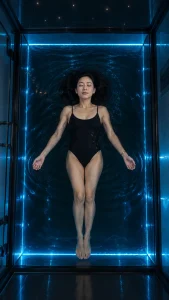
Every float is different, but many people describe a similar arc. You lie on your back in about 25 cm of water with around 500 kg of Epsom salt dissolved in it, warmed to roughly skin temperature (about 34–35 °C), so you float without any effort. In the first minutes you are mostly adjusting: the water feels slightly silky, your ears sit below the surface, and your mind is still busy with the day. Once your body trusts that the water will hold it, muscles start to let go and the line between skin and water seems to blur. In the second half of the session, many people drift into a dreamy, half-awake state, then come back gently when the session ends. The table below sums up what many people notice at each stage, with a small tip for each. New to floating? Start with what float therapy is.
| Time | What many people notice | Tip |
|---|---|---|
| 0–10 min | Getting used to the salt water and buoyancy; some neck and shoulder tension; a busy mind | Let your head fall back; breathe slowly |
| 10–30 min | The body relaxes and weight seems to disappear; time becomes hard to judge | Just notice your breath |
| 30–60 min | A drifting state between waking and sleep; images, colours or memories may appear | Let images come and go |
| Any time | Falling asleep for a few minutes or longer | Normal; you stay afloat |
| End and after | Slowly coming back; a light, clear afterglow | Stand up slowly, shower off the salt, rest in the lounge |
What happens in the first ten minutes?
The first ten minutes are often the noisiest part of the float, even though the room is completely quiet. Your body is not used to being fully supported, so many people hold their head up without noticing, and the neck and shoulders start to ache. Try letting your head fall all the way back: your ears go under, your face stays above the water, and the dense salt water holds your head for you. You may drift and touch the side of the pool; a gentle push sends you back to the middle. At the same time the mind tends to race through to-do lists, unanswered messages and the question “am I relaxed yet?”. That is normal and does not mean you are floating wrong. Instead of fighting thoughts, count your breaths or rest your attention where the water meets your skin. This is why Float Vietnam recommends 90 minutes for beginners: the first part is for settling in.
What is the sensory deprivation tank experience like once you relax?
Once you have settled, many people say the body seems to dissolve into the water: you lose track of where your hands and feet are, and what is left is breath and heartbeat. Time gets slippery; ten minutes can feel like an hour, or the other way round. Later in the session some people drift into a state between waking and sleep that is often linked to theta waves. Images, colours, memories or sudden ideas may come up. Mason and Brady (2009) found that even a short time in a dark, silent room led some people to report perceptual changes, more so in those already prone to such experiences. Some floaters describe these moments as meaningful or even spiritual; read what people report about spiritual experiences. Not everyone has them, and a float without them is still worthwhile.
Many people also fall asleep for a while. Lying on your back in such dense water is very stable, so there is nothing to worry about; see what happens if you fall asleep in the float tank.
Is a sensory deprivation tank scary? What if I panic?
Most people find floating far more comfortable than they expected, but feeling nervous before the first session is very common. Darkness and silence can feel unfamiliar when you are used to noise all day. At Ōmni Space you float in your own private room with its own shower, and you can sit up and step out of the pool at any time; the water is only about 25 cm deep. Most centres also let you control the light, so you can start with it on and switch it off once you feel at ease. If anxiety rises, sit up, take a few slow breaths and lie back down when you are ready. Stopping is not failing. Let the staff know beforehand if you feel uneasy, so they can walk you through everything. If small spaces worry you, our guide to float therapy and claustrophobia has practical tips.
How is your first float different from later floats?
Your first float is mostly an introduction. You spend a lot of it being curious about the feeling of floating, adjusting your position and checking whether you have relaxed yet. So try not to judge floating on one session alone. By the second or third float, body and mind know what to expect, and many people let go faster and spend more time in the deep, drifting part of the session. That is why Float Vietnam suggests floating 2–3 times a month for the first 2–3 months, then 1–2 times a month. At Ōmni Space the intro package is three 90-minute floats for 3,000,000 VND (originally 6,000,000 VND), valid for 3 months, with a free sauna. For a broader picture of what floating involves, from the science to the history, read sensory deprivation tanks: everything you need to know.
How does the couple room feel compared with the single room?
Ōmni Space has two private float rooms. The single room has a rectangular pool for one person, the classic choice if you want to be fully alone with your own mind, with nothing to distract you. The couple room has a square pool for two people, made for partners, friends or family who want to share the experience. Some first-timers feel calmer with someone they know floating nearby; others find it harder to let go because they stay aware of the other person. Neither is better, they are simply different experiences. A tip for the couple room: agree beforehand to stay silent, keep a little space between you and avoid touching, so you can both relax. A 90-minute float costs 2,000,000 VND in the single room and 2,700,000 VND in the couple room; see the full pricing.
Try it at Ōmni Space. Float Vietnam’s float rooms are at 16C Quoc Huong, Thao Dien, Ho Chi Minh City (Saigon), open daily 9:00–21:00. Book a float or read the float therapy FAQ.
Frequently asked questions
Is a sensory deprivation tank scary?
Most people find it more comfortable than they expected. You float in a private room, the water is only about 25 cm deep, and you can sit up and get out at any time.
Do you have to see visuals or hallucinations in a float tank?
No. Some people notice vivid imagery, some fall asleep and some simply feel calm. Every one of these experiences is normal.
Is it okay to fall asleep while floating?
Yes. The Epsom salt water is so dense that you stay afloat on your back, and falling asleep during a float is common.