Updated: 12 October 2026 · Compiled by Float Vietnam
Key takeaways
- “Red pill” comes from The Matrix (1999): taking the red pill means choosing an uncomfortable truth over a comfortable illusion.
- Online today it has at least three meanings: a joke about “waking up”, a political term, and the name of a set of beliefs about men and women.
- Researchers have raised concerns about misogyny and radicalisation in some red-pill communities; many young men are drawn in by loneliness or a wish to improve themselves.
Quick answer: “Red pill” originally meant “choosing the truth, even when it hurts”, from the scene in The Matrix where Morpheus offers Neo two pills. From around 2012, some online men’s communities used “red pill” for the belief that society is stacked against men. So the same phrase can be a joke for one person and an ideology for another. What it means depends on who is using it.
Where it comes from: the two pills in The Matrix
In The Matrix (1999), written and directed by the Wachowskis, Morpheus offers Neo two pills. Take the blue pill and he wakes up in bed believing whatever he wants. Take the red pill and he stays “in Wonderland” and sees “how deep the rabbit hole goes”, meaning he learns the truth about the simulated world. Since then, blue has stood for the comfort of not knowing, and red for facing the truth, however painful.
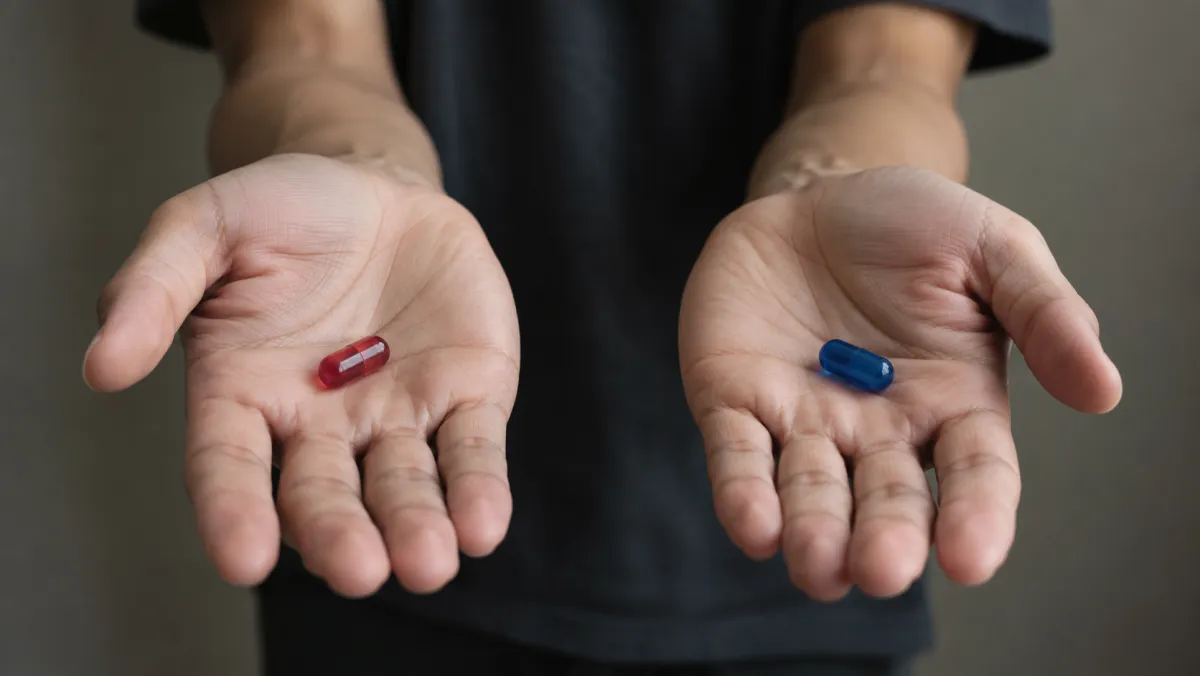
Interestingly, the filmmakers saw the story differently. In 2020, Lilly Wachowski confirmed that a trans narrative was “the original intention” of the film: a story about the desire for transformation. That same year, when public figures used “Take the red pill” as a political reference on Twitter, she publicly rejected that use.
How the meaning changed
Today “red pill” is used in three main ways:
- An everyday meme: “taking the red pill” means suddenly seeing an uncomfortable truth, such as realising you have been used.
- A political term: from the late 2000s, “redpilled” was used online for being won over to far-right views; researchers Lewis and Marwick (2017) describe it as a gateway into those ideas.
- A belief system about gender: the subreddit r/TheRedPill launched in 2012, arguing that society disadvantages men and offering advice on dating and power. In 2018 Reddit quarantined it (hidden from search, with a warning screen); a later study found new-user arrivals fell by about 80%.
The wider network around these groups is often called the “manosphere”: men’s rights activists, pickup artists, “Men Going Their Own Way” (MGTOW) and incels (involuntary celibates).
| Term | Common meaning online |
|---|---|
| Blue pill | Holding comfortable, mainstream views; in red-pill circles often used as a put-down for being naive |
| Black pill | A fatalistic offshoot from incel forums: the belief that looks and genes decide your fate |
| Purple pill | Sometimes used for a middle position that accepts some ideas and rejects others; no settled definition |
| Alpha / beta / sigma | A ranking of men by “status” popular in this content; researchers treat it as a cultural story, not science |
The red-pill influencer wave
From the late 2010s, short videos on TikTok, YouTube and Instagram took “red pill” ideas out of the forums and in front of millions of young viewers. The content often mixes advice on fitness, money and discipline with views about women and relationships. The best-known name is Andrew Tate, a former kickboxer, who faces criminal charges in Romania and the UK and denies all of them.
What research says
Researcher Debbie Ging (2019, Men and Masculinities) mapped the groups in the manosphere and argued that they are built around a sense of grievance and victimhood. Ribeiro and colleagues (2021) analysed 28.8 million posts and found older, milder groups being overtaken by more extreme ones, with many users moving between them.
On mental health, a 2025 Movember survey of more than 3,000 men aged 16–25 in the UK, US and Australia found about two-thirds regularly watch “masculinity influencers”. Of those, 43% found them motivating, while 27% reported feeling worthless. These are associations, not proof of cause.

Why it draws young men in
Looked at with empathy, the reasons are understandable. One is loneliness: a 2021 US survey found the share of men with no close friends rose from 3% in 1990 to 15% in 2021, although other data show only a small gap between men and women. Another is the wish for self-improvement and direction: much of the content is about the gym, discipline and money, all reasonable goals. A third is economic pressure and the feeling of being left behind. When real needs like these meet a simple story about who is to blame, it is easy to get pulled in.
“Red pill” in Vietnam
In Vietnam, “red pill” shows up on TikTok, Facebook and in groups such as “Red Pill VN”. It is used as a “wake-up” meme, as dating slang (for example, “taking the red pill” on realising a partner only values your money), and in some men’s groups that mix self-improvement with anti-feminist views. Some Vietnamese writers note that the local version often copies Western debates without their context. There is no reliable data on how big the trend is.
Healthier ways to level up
If what draws you in is the wish to be stronger and more confident, there are paths with solid research behind them:
- Move regularly: a network meta-analysis of 218 trials (Noetel et al., 2024, BMJ) found walking, jogging, yoga and strength training clearly reduced depression.
- Invest in real friendships: a review of 148 studies (Holt-Lunstad et al., 2010) linked strong social ties with about a 50% higher likelihood of survival.
- Mindfulness and quiet time: mindfulness programmes show moderate evidence for easing anxiety and depression (Goyal et al., 2014).
- Talk to a professional when things feel heavy.

An hour of float therapy is another way to find quiet: no phone, no algorithm, just you and your thoughts. Read alone with your thoughts while floating and Float Vietnam’s view on mental “shortcuts”.

Try it at Ōmni Space. Float Vietnam’s float rooms are at 16C Quoc Huong, Thao Dien, Ho Chi Minh City (Saigon), open daily 9:00–21:00. Book a float or read the float therapy FAQ.
Frequently asked questions
What does “red pill” mean?
From The Matrix: choosing an uncomfortable truth over a comfortable illusion. Online today it can be a joke, a political term or the label for a set of beliefs about men and women.
What is the difference between the red pill and the blue pill?
Red stands for “seeing the truth”, blue for “staying comfortable”. In men’s online groups, “blue pill” is often used as a put-down.
What is the black pill?
A fatalistic offshoot from incel forums: the belief that looks decide your fate and nothing can change. Researchers link it with hopelessness.
Is “red pill” a bad thing?
The phrase itself is neutral. Researchers have raised concerns about misogyny and radicalisation in some red-pill communities, while many people come for the self-improvement content. What matters is the specific content you are watching.
Where do I start with healthy self-improvement?
Move regularly, invest in real friendships, make time for quiet such as meditation or floating, and talk to a professional when things feel heavy.