Updated: 12 October 2026 · Compiled by Float Vietnam
Key takeaways
- “Steroid” is a family of molecules, not one drug. Corticosteroids are anti-inflammatory medicines (asthma, eczema, arthritis), they do not build muscle, and they must never be stopped suddenly.
- Anabolic-androgenic steroids (AAS) are testosterone and its derivatives. They really do build muscle, but large Danish data link use to about 3 times the risk of heart attack and nearly 9 times the risk of cardiomyopathy, and about 30% of users become dependent.
- SARMs are not “safe steroids”: none is FDA-approved and about half of online products are mislabelled. Natural muscle comes from training, protein, creatine, sleep and patience; floating only supports rest and replaces nothing.
Important: this article is for information only. It does not explain how to use any substance and does not replace medical advice. If you take a prescribed corticosteroid (an asthma inhaler, prednisolone tablets, a cream), do not stop or change the dose on your own; ask your doctor. If you use or have used anabolic steroids, see an andrology or endocrinology doctor.
Quick answer: Steroids are a family of molecules with a four-ring backbone, including the cholesterol, cortisol and testosterone your body makes every day. People usually mix up two very different groups: corticosteroids, anti-inflammatory medicines prescribed by doctors that do not build muscle, and anabolic-androgenic steroids (AAS), testosterone and its derivatives, which some gym-goers take at doses several times higher than medical replacement to build muscle. AAS work, and that is the problem: the price is paid by the heart, hormones, fertility and mental health.
“Steroid” is a family, not a drug
Chemically, a steroid is any molecule with three six-carbon rings and one five-carbon ring. Cholesterol, vitamin D precursors, cortisol, oestrogen, progesterone and testosterone all belong to it. Your body makes steroids every day. Confusion starts when one word covers very different medicines.

| Group | What it is | Key point |
|---|---|---|
| Corticosteroids | Man-made versions of cortisol: prednisolone, hydrocortisone, dexamethasone, asthma inhalers, creams | Reduce inflammation and calm the immune system. They do not build muscle; long-term high doses can even waste it |
| Anabolic-androgenic steroids (AAS) | Testosterone and synthetic derivatives. “Anabolic” means tissue-building, “androgenic” means masculinising | What people mean by “steroids” in gyms. Real medical uses exist, but most non-medical use is far above medical levels |
| SARMs | Non-steroidal drugs aimed at the androgen receptor in muscle and bone | No SARM is FDA-approved; WADA has banned them at all times since 2008 |
| Prohormones | Compounds the body converts into active androgens | Sold as US supplements until a 2004 law |
| TRT | Prescription testosterone that brings levels back to the normal range in men with diagnosed hypogonadism | A medical treatment, unlike supraphysiological use |
Public-health researchers also use “IPEDs” (image and performance enhancing drugs), which covers AAS, SARMs, growth hormone and more. In the gym you will hear two slang words: “natty” (natural, drug-free) and “fake natty” (claims to be natural but uses drugs).
Corticosteroids: the steroids your doctor prescribes
Corticosteroids treat asthma, COPD, eczema, rheumatoid arthritis, inflammatory bowel disease, severe allergies, some cancers and transplants. For many people they are life-saving. Inhaled and topical forms carry much lower whole-body risk than tablets, and short courses usually cause few problems.
With long-term or high-dose use, side effects can include weight gain, increased appetite, raised blood sugar, high blood pressure, osteoporosis, cataracts, infections, mood changes, insomnia, thin skin and muscle weakness. Even short courses are not risk-free: in claims data on 1.5 million US adults, 21.1% received at least one oral course shorter than 30 days over three years, and sepsis, blood clots and fractures increased in the 30 days after starting (Waljee 2017). The lesson is not to fear the medicine, but to use it when it is truly needed.
The most important rule: never stop suddenly
Taking steroid tablets for more than about 3–4 weeks can switch off the body’s own cortisol production. Stopping suddenly can trigger adrenal insufficiency or a life-threatening adrenal crisis, so the prescriber tapers the dose, and the risk can last up to 12 months after stopping. In the UK, people on long-term steroids carry a Steroid Emergency Card. The simple rule: do not stop, do not cut down, ask your doctor.

A short history of the muscle steroids
1935: testosterone, and the Nobel story told wrong
In 1935 Ernst Laqueur in Amsterdam (with Organon) isolated testosterone from bull testes and named it. The same year Adolf Butenandt in Germany and Leopold Ružička in Switzerland synthesised it independently, months apart. They shared the 1939 Nobel Prize in Chemistry, but the citations are often misreported: Butenandt’s was “for his work on sex hormones”, while Ružička’s was for polymethylenes and higher terpenes, not formally for testosterone. The Nazi government forced Butenandt to decline the prize.
1954–1958: the Cold War on the lifting platform
According to US team doctor John Ziegler’s own later account, at the 1954 World Weightlifting Championships in Vienna a Soviet team doctor told him over drinks that Soviet lifters were using testosterone. It is a secondhand story. Ziegler then worked with Ciba, Dianabol reached the US market in 1958 and spread among weightlifters, and Ziegler later came to regret his role.
The golden era
The 1960s–70s were bodybuilding’s golden era: Muscle Beach, Gold’s Gym, Mr. Olympia. Steroids were legal with a prescription and widely used. Arnold Schwarzenegger, seven-time Mr. Olympia (1970–75 and 1980), has said openly that he used them under a doctor’s supervision while they were legal and has no regrets, and in later years he warned about today’s drug excess in the sport.
East Germany, Ben Johnson, BALCO and Armstrong
- East Germany, 1974–1989: a secret programme, State Plan 14.25, built mainly on Oral-Turinabol, reached an estimated 10,000 athletes (some sources say up to 15,000), including minors who were often told the pills were “vitamins”. Harms included virilisation of women, liver damage, infertility, miscarriages and depression. Brigitte Berendonk and Werner Franke exposed it (Franke & Berendonk 1997), and in January 2025 the Bundestag recognised the victims as a victim group.
- Ben Johnson, Seoul 1988: he won the 100 m in 9.79 s on 24 September, tested positive for stanozolol and lost the gold three days later; it went to Carl Lewis. A second positive brought a life ban in 1993, and Canada held the Dubin Inquiry in 1989.
- US law: in 1990, 27 anabolic steroids were placed in Schedule III, and in 2004 prohormones such as androstenedione and THG were added.
- BALCO, 2003: coach Trevor Graham sent a syringe to USADA, and Don Catlin’s UCLA lab identified THG, “the Clear”, a designer steroid made to evade tests. Marion Jones admitted use in 2007 and was stripped of her Sydney 2000 medals.
- Lance Armstrong, 2012: USADA stripped his seven Tour de France titles and banned him for life. His case was mainly about EPO and blood transfusions (endurance, not muscle), although the charges also included testosterone and corticosteroids: one case, both meanings of “steroid”.
Gym culture: from Zyzz to the Liver King
Social media moved the steroid story from the podium to everyone’s phone. Aziz Shavershian, known as Zyzz, was an early YouTube “aesthetics” icon from Sydney. He died on 5 August 2011 in Pattaya, Thailand, aged 22. His death was reported as heart-related; a role for steroids was widely speculated but never established, and his family deserves that care.
The 2010s produced a whole “Natty or Not” genre analysing whether influencers use drugs. It brought PED talk into the open and also normalised it. The biggest shock came in late 2022: Brian Johnson, the “Liver King”, promoted “ancestral living” and raw organ meat and denied steroid use. In late November, leaked emails showed a large enhancement regimen, mainly growth hormone, and in early December he posted an apology admitting he had lied and had used steroids.
“Fake natty” is not just gossip. It sells programmes and supplements to young men who believe they can reach that body naturally, and who then feel like failures. Some influencers now disclose their use: more honest, but it can also make drug use look normal.

Do they work? Yes, and that is the problem
For years doctors told athletes steroids “don’t really work”. Lifters saw the opposite, and trust in medicine suffered. In 1996 Bhasin’s randomised trial in 43 healthy men settled it: supraphysiological testosterone increased muscle size and strength even without exercise, and the group that also trained gained most. Being honest about this is what makes the next section credible.
What anabolic steroids cost the body
The heart: the Danish cohort
Baggish (2017) studied 140 male weightlifters aged 34–54: long-term AAS users had weaker heart pumping (ejection fraction 52% vs 63%) and more coronary plaque, which grew with years of use. Denmark offers unique data from gym doping tests. Windfeld-Mathiasen and colleagues (2025) followed 1,189 men caught using AAS (2006–2018) against 59,450 matched controls for about 11 years. Adjusted risks were:
- Heart attack: about 3 times higher (HR 3.00)
- Cardiomyopathy: about 8.9 times higher
- Heart failure: about 3.6 times higher
- Venous blood clots: about 2.4 times higher
- Arrhythmias: about 2.3 times higher
The Endocrine Society statement (Pope 2014) lists the mechanisms: thickened heart muscle, worse cholesterol (HDL falls), high blood pressure, thicker blood and clotting.
Mortality
In the same Danish data, death rates were about three times higher among AAS users, from both natural causes (cancer, heart disease) and unnatural ones such as accidents, violence and suicide (Windfeld-Mathiasen 2024); an earlier study of 545 gym users found a similar picture (Horwitz 2019). These are observational data, so the accurate phrase is “linked to”, not “causes”.
Hormones, fertility and the body
External androgens switch off the brain–testis axis: testes shrink, sperm counts fall or vanish, and after stopping testosterone crashes, bringing fatigue, low libido and low mood (Rahnema 2014). Rasmussen (2016) found that former users, on average 2.5 years after stopping, still had lower testosterone and more hypogonadal symptoms than controls. Add breast tissue in men, acne, hair loss, tendon ruptures and liver damage (mainly from oral forms). In women: deeper voice, facial hair and menstrual changes, often irreversible.
Mental health: “roid rage”, dependence and bigorexia
In Pope’s placebo-controlled trial (2000), high-dose testosterone raised mania and aggression scores, but responses varied hugely: most men had minimal effects, while a minority (8 of 50) had clear hypomanic or manic reactions, and no one could predict who. “Roid rage” is real for some, not most. The bigger mental-health risks are depression after stopping and dependence.
About 30% of AAS users develop a dependence syndrome (Kanayama 2009). An estimated 2.9–4 million Americans aged 13–50 have used AAS and roughly 1 million may have been dependent; only 22% started before age 20 (Pope 2014). The loop: feeling too small drives use, and the low mood of post-use hormone crashes drives restarting.
That feeling has a name: muscle dysmorphia, or “bigorexia”. Pope and colleagues described it in 1997 as a form of body dysmorphic disorder in which people see themselves as small however big they are; DSM-5 (2013) lists it as a specifier of that disorder. Mitchell’s 2017 review of 31 studies linked it to competitive bodybuilding, low self-esteem, perfectionism and AAS use. Worldwide, about 3.3% of people have used AAS at some point (Sagoe 2014), mostly recreational gym-goers chasing a look, not elite athletes.
If mirrors, scales and comparisons are taking over, or you feel low or hopeless, talk to a doctor or psychologist. In Vietnam, the Ngày Mai support line is 096 306 1414; in an emergency call 115.

SARMs and “safe alternatives” online
SARMs are marketed as “safe, legal steroids”. In 2017 the FDA warned consumers and sent warning letters to companies selling them, stressing they are unapproved drugs, not supplements, with risks of liver toxicity, heart attack and stroke and unknown long-term effects. No SARM is FDA-approved. A JAMA study (Van Wagoner 2017) bought 44 online “SARM” products: only 52% contained a SARM, 39% contained other unapproved drugs, 9% contained nothing active, and most labels were wrong. SARMs still suppress natural testosterone, and WADA bans them at all times.
Even ordinary supplements carry risk: of 634 non-hormonal products from 13 countries, 14.8% contained undeclared anabolic steroids (Geyer 2004), and the FDA has repeatedly warned about “bodybuilding” products with steroid-like compounds causing serious liver injury.
The “natty” debate: how big can you get naturally?
In 1995 Kouri and colleagues measured the height-normalised fat-free mass index (FFMI) of 157 male athletes. Among non-users the upper limit was about 25; pre-steroid-era Mr. America winners (1939–1959) averaged 25.4; many users exceeded 25 and some exceeded 30. But the sample was small and old, the authors called it preliminary, a few genetically unusual natural athletes exceed 25, and body-fat estimates carry error. FFMI explains why many online physiques are unlikely to be natural; it is not a tool for judging individuals.
Another grey zone is the “low-T” clinic. Proper TRT follows the Endocrine Society guideline (Bhasin 2018): symptoms plus low morning testosterone on at least two tests. The TRAVERSE trial (Lincoff 2023) in 5,246 men aged 45–80 found TRT to the normal range did not increase major cardiovascular events versus placebo (7.0% vs 7.3%). That applies to medical TRT, not to supraphysiological use.
| Claim | Evidence |
|---|---|
| High-dose AAS build muscle and strength | Strong |
| Long-term AAS use is linked to heart disease and plaque | Strong |
| AAS users have about 3 times the death rate | Promising (observational) |
| About 30% of users become dependent | Promising |
| “SARMs are safer than steroids” | No good evidence |
| Natural lifters rarely exceed an FFMI of about 25 | Early |
| Non-medical high-dose AAS use | Harmful |
Vietnam: real cases, no numbers yet
There is no survey of steroid or SARM use in Vietnamese gyms, so this article gives no prevalence figure. What exists are case reports and doctors’ warnings:
- Tâm Anh General Hospital, HCMC (August 2023): a 30-year-old man who had injected testosterone for years to build muscle had shrunken testes, a sperm count about one tenth of normal and motility under 10%. After stopping, sperm counts improved over months, but IVF might still be needed (Dr Phạm Xuân Long, Andrology).
- Tuổi Trẻ (21 October 2024): Dr Trần Văn Dương (Sports Medicine, Nhân Dân 115 Hospital) said cases linked to muscle-building “miracle drugs” are rising, especially in big cities, driven by online and e-commerce sales; most affected are men aged 18–35 who often do not know what the product contains. He listed endocrine, liver, kidney, heart, psychiatric and tendon harms and stressed that these products require a doctor’s prescription.
In sport, doping is governed by the Law on Physical Training and Sports 77/2006/QH11 (amended 2018) and Circular 17/2015/TT-BVHTTDL (amended by Circular 01/2023/TT-BVHTTDL), which apply the WADA Code. Vietnam joined the Copenhagen Declaration, and the government approved joining the UNESCO Convention against Doping in Sport. In June 2023 five Vietnamese track athletes were stripped of SEA Games 31 medals after positive tests, and six bodybuilders had been dropped before those Games after positive tests.
Building muscle naturally: what actually works
- Progressive overload and enough volume: more weekly sets produce more growth, up to a point (Schoenfeld 2017).
- Enough protein: a meta-analysis of 49 trials (Morton 2018) found protein modestly boosts gains, with the benefit plateauing at a total intake of about 1.6 g per kg of body weight per day.
- Creatine: the best-studied legal supplement for strength and lean mass, and safe in healthy people (Kreider 2017).
- Sleep: one night without sleep cut muscle protein synthesis by 18%, raised cortisol by 21% and lowered testosterone by 24% (Lamon 2021, a small study of 13 people).
- Patience: natural gains slow sharply after the first one to two years. That is normal, not failure.
Muscle is built while you rest, not while you lift. Read more on evidence-based biohacking, float therapy and sleep and floating vs cold plunge.

Where floating fits (modestly)
To be clear: floating will not add muscle, raise testosterone or replace anything in this article. It is a rest tool for people training hard and naturally. Small studies in athletes hint at recovery benefits: Driller & Argus (2016) reported better mood and less perceived soreness in elite athletes, and Broderick and colleagues (2019), with 19 male team-sport athletes, reported benefits for sleep, perceived fatigue and some performance measures after a 60-minute float versus 60 minutes of passive rest. Evidence for sports recovery and sleep: Early.
The firmer evidence is on the mind. For relaxation, stress and anxiety relief, float therapy is rated Strong: consistent trials (Kjellgren 2014, Feinstein 2018), 85–89% of participants completing their programme (Garland 2024), and in one survey 92% felt relaxed and 77% less stressed (Hilpert & Ster 2025, preprint). Hruby (2024) found that a softer sense of the body’s boundary while floating partly explained the drop in anxiety. For someone stuck in “never big enough”, an hour in the dark is an hour away from the mirror. It is not a therapy for muscle dysmorphia; if that is you, a psychologist is the right first step.
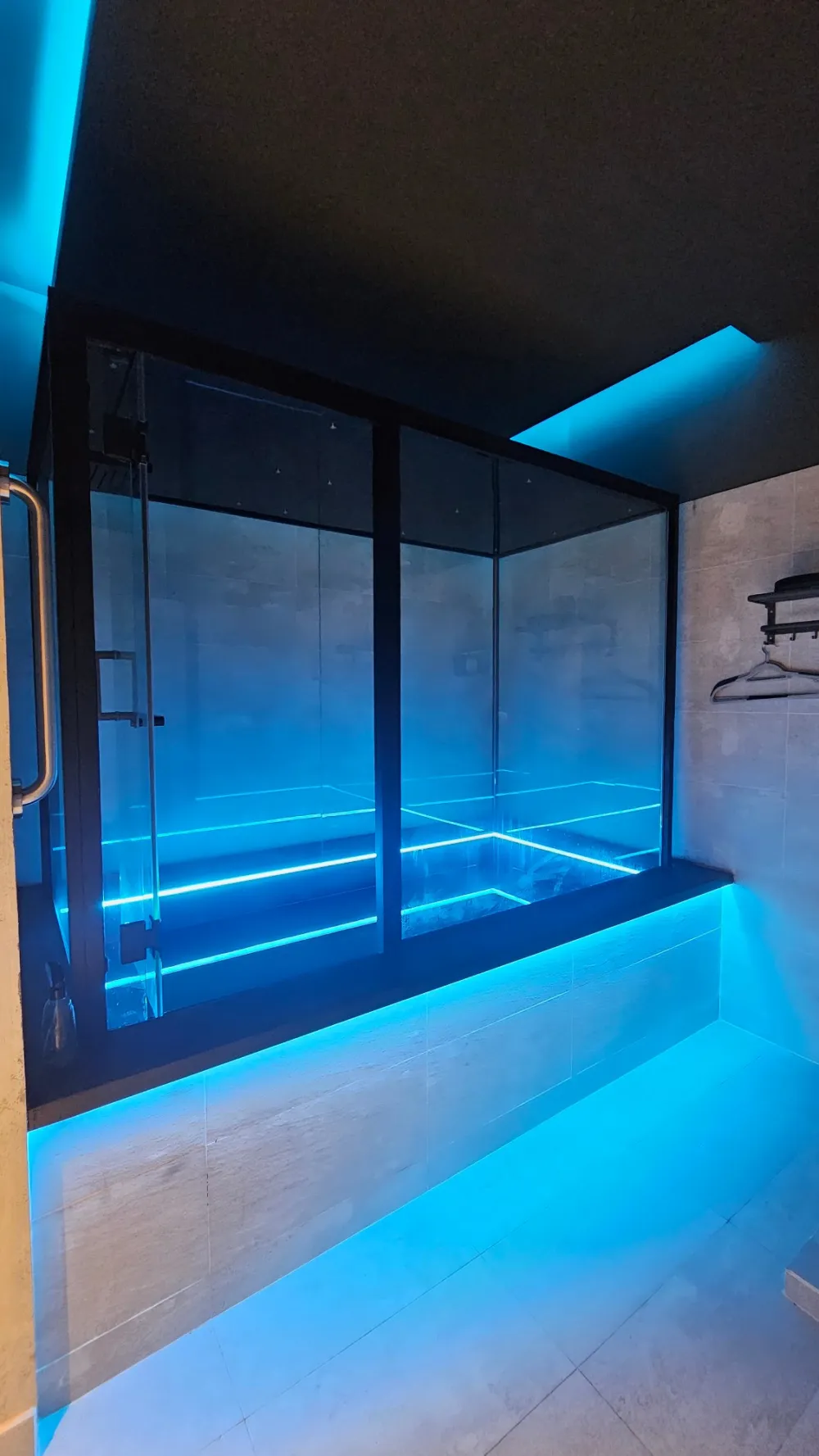
See also floating for athletic performance, athletes and float recovery, is float therapy safe? and the Laureate Institute research. To try it in Saigon, see the services at Ōmni Space.
If you use or have used
- See an andrology or endocrinology doctor and be honest; they can check your heart, liver, hormones and fertility.
- If you take a prescribed corticosteroid, do not stop or change it on your own; ask your doctor.
- Low mood, lost motivation or dark thoughts, especially after stopping, deserve help now: Ngày Mai 096 306 1414, or 115 in an emergency.
- If worry about your body takes up too much of your life, a psychologist can help. Read more on calming the mind without substances and the “red pill” and young men online.
Key sources
- Bhasin et al. 1996, NEJM
- Franke & Berendonk 1997, Clinical Chemistry
- Baggish et al. 2017, Circulation
- Windfeld-Mathiasen et al. 2025, Circulation
- Windfeld-Mathiasen et al. 2024, JAMA
- Rasmussen et al. 2016, PLoS One
- Kanayama et al. 2009, Addiction
- Pope et al. 1997, Psychosomatics
- Van Wagoner et al. 2017, JAMA
- Kouri et al. 1995, Clinical Journal of Sport Medicine
- Waljee et al. 2017, BMJ
- Morton et al. 2018, British Journal of Sports Medicine
- Lamon et al. 2021, Physiological Reports
- Broderick et al. 2019, Performance Enhancement & Health
Note: This page is for general information. Float therapy supports wellbeing but does not replace diagnosis or treatment by a doctor. If you have a medical condition, ask your doctor before floating.
Try it at Ōmni Space. Float Vietnam’s float rooms are at 16C Quoc Huong, Thao Dien, Ho Chi Minh City (Saigon), open daily 9:00–21:00. Book a float or read the float therapy FAQ.
Frequently asked questions
Is my asthma inhaler the same “steroid” bodybuilders use?
No. Inhalers contain corticosteroids, which calm airway inflammation at very low doses and do not build muscle. Gym “steroids” are anabolic-androgenic steroids (testosterone derivatives), a different group. Never stop a prescribed steroid on your own; ask your doctor if you are worried.
Are SARMs safer than steroids?
There is no good evidence they are. No SARM is FDA-approved, the FDA warns of liver and cardiovascular risks, and a 2017 JAMA study found only about half of online “SARM” products actually contained one. WADA bans them at all times.
How can you tell if someone is “natty”?
You cannot be sure by looking. A 1995 study found natural lifters rarely exceeded a fat-free mass index of about 25, but that is a rough guide, not a test. The more useful point: do not measure your body against online physiques, because many “natural” ones are not.
Does the body fully recover after stopping anabolic steroids?
Not always. Danish research found former users still had lower testosterone and more hypogonadal symptoms years after stopping, and fertility can be affected. If you are concerned, see an andrology or endocrinology doctor.
Can floating build muscle or replace steroids?
No. Floating does not build muscle or raise hormones. A few small studies in athletes suggest it may ease soreness and improve sleep, and sleep is one of the natural factors that clearly matters for muscle repair.