Updated: 13 October 2026 · Compiled by Float Vietnam
Key takeaways
- Eleven’s tank is fiction built around a real object: the isolation tank John C. Lilly first built at the US National Institute of Mental Health in 1954. The psychic powers and the monsters are invented.
- Real float therapy (flotation-REST) uses skin-temperature water with so much Epsom salt that your body floats on its own. Nothing is attached to you, you control the light, and you can get out at any time.
- Research on floating for stress and anxiety relief is rated Strong. Perceptual changes are mild and rare, and there is no data showing the show caused a float boom.
This is an independent article by Float Vietnam. It is not affiliated with, sponsored or endorsed by Netflix or the creators of Stranger Things; we name the show only to discuss it. Spoiler note: the episode map below covers events up to the series finale.
Quick answer: Partly. Sensory deprivation tanks are real, and the kids in season 1 were roughly right about the salt: they say they need 1,500 lb (about 680 kg), and Popular Science later estimated that a 6-foot kiddie pool would need around 1,183 lb. Everything else is fiction. A real float tank gives no psychic abilities, nothing is attached to your body, and the water is shallow and dense enough that a relaxed body floats face-up by itself. Most people simply come out deeply relaxed.
The scene everyone remembers: a kiddie pool and 1,500 pounds of salt
In “Chapter Seven: The Bathtub” (season 1, episode 7, released 15 July 2016), Eleven has to find Will and Barb, but in the show she needs a tank, or a “bath”, to focus her remote viewing. Dustin phones the science teacher, Mr. Clarke, to ask how you would build a sensory deprivation tank. Clarke answers the question in general terms but gives no salt amounts. The plan itself comes from the kids: they take the kiddie pool that had been used for apple bobbing at Hawkins Middle School, fill it with water and agree they need 1,500 lb of salt, which they take from the school’s rock salt used for de-icing.
In that makeshift tank, Eleven finds Barb dead and Will alive in the Upside Down, hiding in his fort, Castle Byers. It is a striking scene, and for many viewers it became their first picture of what a “sensory deprivation tank” is.
So was 1,500 lb realistic? Popular Science did the maths in August 2016. A 6-foot kiddie pool holds about 194 gallons, and making that water dense enough to float in would take roughly 1,183 lb (about 537 kg) of salt. The kids were in the right range, if a little high. Real float tanks use Epsom salt (magnesium sulphate), not road salt, and depending on their size they hold roughly 400–800 kg of it. Each pool at Ōmni Space, 1.2 × 2.4 m with about 25 cm of water, holds around 500 kg.
Every tank scene in Stranger Things: an episode map
The tank turns up at key moments across the five seasons. We describe each scene only as far as we could check it against episode guides; dates are the release dates.
| Episode | Released | What happens with the tank |
|---|---|---|
| S1E5 “The Flea and the Acrobat” | 15 Jul 2016 | In a flashback at Hawkins Lab, Eleven is put in a sensory deprivation tank to eavesdrop telepathically on a Soviet man. During the session she comes across the monster, the Demogorgon. |
| S1E7 “The Bathtub” | 15 Jul 2016 | The kids build a makeshift tank from a school kiddie pool and salt water. Eleven finds Barb dead and Will alive in the Upside Down. |
| S4E5 “The Nina Project” | 27 May 2022 | In a Nevada missile silo, Dr. Owens and Dr. Brenner put Eleven in a specialised tank called NINA, so she can relive buried memories of Hawkins Lab and regain her powers. |
| S4E9 “The Piggyback” | 1 Jul 2022 | Her friends build another improvised tank so Eleven can enter Max’s mind while Vecna is there. Vecna overwhelms her, and Mike’s declaration of love helps her break free. |
| S5E8 “The Rightside Up” (finale) | 31 Dec 2025 | At Hawkins Lab, Hopper, Murray and Kali prepare a tank. Eleven uses it to enter the mind of Henry Creel/Vecna, and Max and Kali are pulled in with her. Vecna shows Hopper a false vision, and Hopper pulls Eleven out of the tank. |
Between those scenes the rules shift. By season 2, Eleven can project her mind without any tank at all. The black, endless space she enters is usually called “the Void” by fans and press. The back-story reaches further: Eleven’s mother, Terry Ives, is portrayed as a subject of MKUltra-style experiments who was submerged in sensory deprivation tanks.
Across all of it, the tank is a tool in someone else’s experiment, and the sessions are frightening: nosebleeds, monsters, and in the finale, life-or-death stakes. That makes great television. It is also close to the opposite of what a float session is designed to be.
Where the idea came from: Montauk, MKUltra and Altered States
A show that began as Montauk
Stranger Things was first developed under the title Montauk, set in Montauk, New York. Netflix ordered the series under that name on 2 April 2015, and it was renamed Stranger Things in August 2015. The Montauk Project is a conspiracy legend about secret experiments at Camp Hero on Long Island, and the Duffer brothers reportedly drew partly on it before moving the story to the fictional town of Hawkins.
MKUltra: the Cold War backdrop
In 2016, Rolling Stone tied Hawkins Lab to MKUltra, the real CIA programme that ran from 1953 into the early 1970s, and noted that the Duffers wanted the supernatural to feel grounded in science. Sensory deprivation and isolation were among MKUltra’s methods. Most of its files were destroyed in 1973, and the programme became public through the Church Committee and Rockefeller Commission reports in 1975 and Senate hearings in 1977. More broadly, sensory deprivation research in the 1950s and 60s was funded by NASA, the US Air Force and, covertly, the CIA, partly with interrogation in mind.
This is where history and myth part ways. The float tank was born in a government health lab during the same Cold War years when the CIA was secretly funding sensory deprivation research, but there is no documented evidence that John Lilly’s tank was part of MKUltra. Lilly later wrote that intelligence agencies approached him and that he refused classified work because he wanted his research to stay open. That is his own account and has not been independently confirmed.
Altered States, the film behind the lab tank
Brenner’s isolation experiments were reportedly heavily influenced by the chamber in Altered States (1980), according to a summary of the Duffers’ own walk-through of the show’s film references. Directed by Ken Russell and starring William Hurt, the film was based on Paddy Chayefsky’s 1978 novel, which drew on Lilly’s isolation tank and psychedelic research. We found no statement in which the Duffers name Lilly himself, so the link runs indirectly: from Lilly, to Altered States, to Hawkins. Whether the film helped the young float industry is disputed. Floating’s popularity peaked around its release, yet later writers felt it did little for floating’s image.
The real history: from Lilly’s upright tank to the modern float room
1954: John C. Lilly at NIMH
In 1954, while working at the US National Institute of Mental Health (NIMH) in Bethesda, the neuroscientist John C. Lilly devised the first isolation tank: dark, soundproof and filled with warm water. Lilly and a colleague were its first subjects. It looked nothing like a modern float room. The tank was upright, and writers have compared it to a standing coffin. The subject hung vertically in the water with the head enclosed in a full-face breathing mask, in a tank originally built for Navy experiments on divers’ metabolism. Lilly first reported the work in a 1956 paper on the mental effects of reducing ordinary stimulation, and much later described his tank technique in the book The Deep Self (1977).
From the early 1960s, Lilly also took LSD while floating, and wrote about it in books such as The Center of the Cyclone (1972). That was drug-plus-tank self-experimentation, and it has nothing to do with a modern float session. If you are curious about that side of the story, our explainer What are psychedelics? covers the research and the risks.
1972: the Perrys and the Samadhi tank
In 1972, Glenn Perry, a computer programmer, attended a five-day workshop with Lilly. With Lee Perry he then started the Samadhi Tank Company, named after a Sanskrit word for deep meditative absorption, and began building the first commercial and home tanks. A 1982 newspaper reported they sold about 10 tanks in their first year. Samadhi-style tanks helped make the modern design familiar: you lie face-up in about 25 cm of water dense with Epsom salt, with no diving suit and no mask.
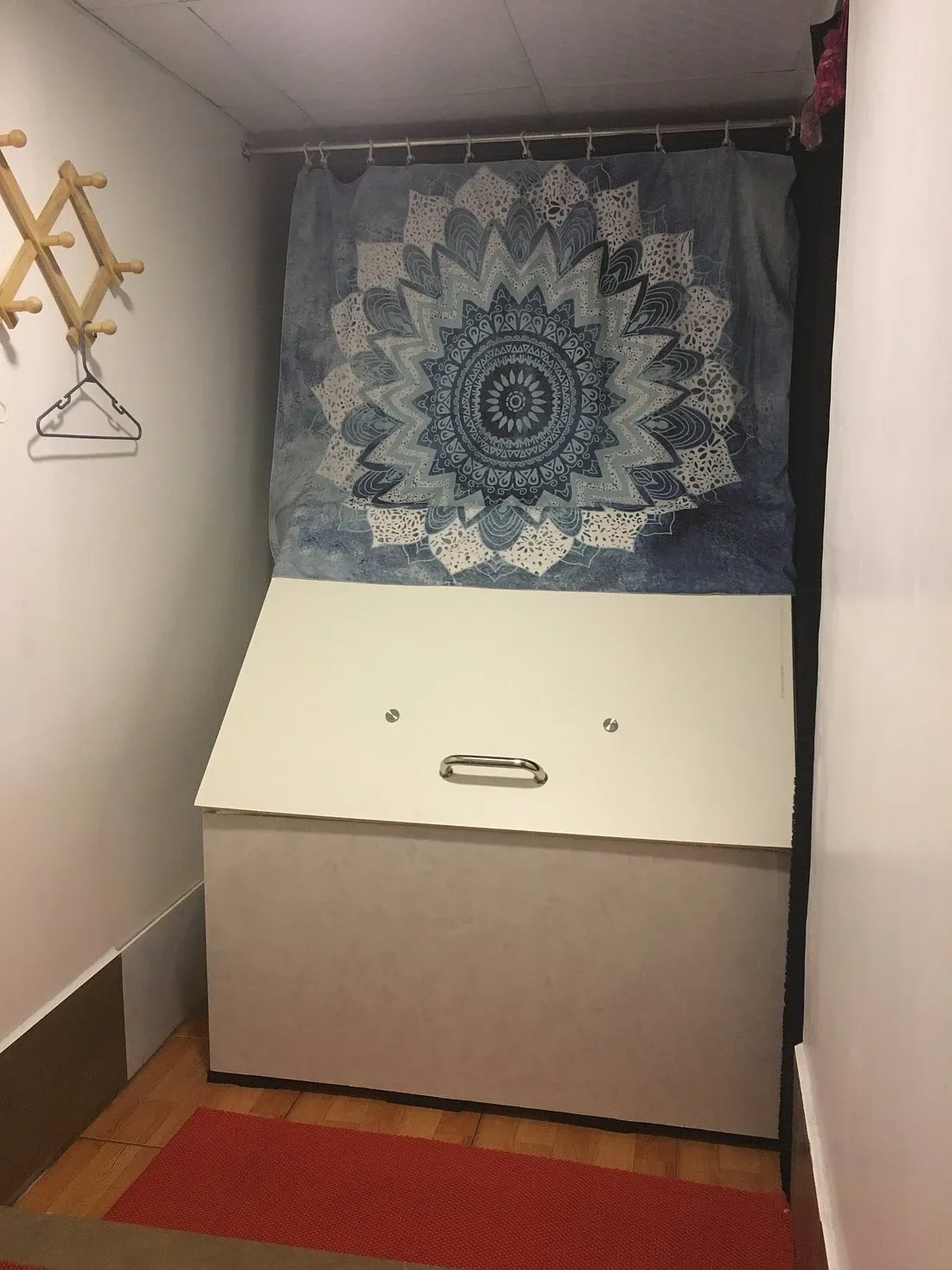
The first commercial float centre opened in the Beverly Hills/Los Angeles area in 1979 (per most sources). By 1981 the US float industry was worth about $4 million in sales and rentals, and the Float Tank Association was formed the same year. Then came a long slump. Psychologist Peter Suedfeld put it down to operators’ business naivety and too few repeat customers; other commentators blame the mid-1980s fear of AIDS.
From “sensory deprivation” to REST
Suedfeld, at the University of British Columbia, and Roderick Borrie coined the term REST (Restricted Environmental Stimulation Technique or Therapy) to replace the loaded phrase “sensory deprivation”. REST comes in two forms: chamber REST, lying in a dark, quiet room, and flotation REST, which is what float centres offer today. Their 1999 review (Suedfeld & Borrie 1999) summarised the health and therapeutic uses of both. For the full story, read the history of float therapy, what sensory deprivation really means and the types of float tanks, from Samadhi to float rooms.
Fiction vs reality: what a float tank really does
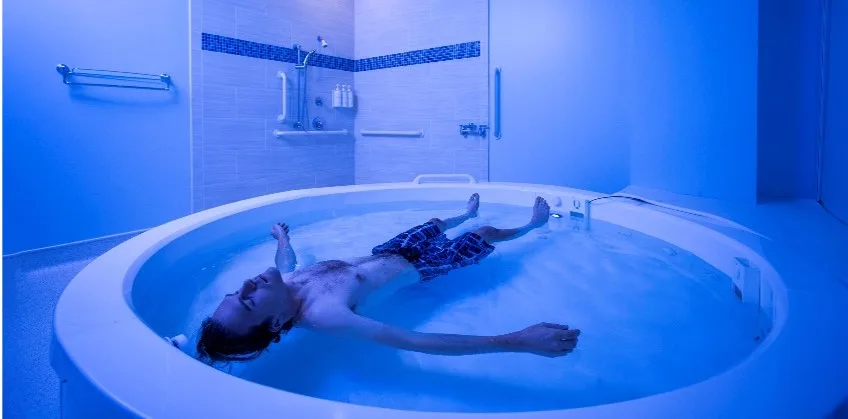
Here is how the show’s tank compares with a real float session, point by point.
| Topic | In Stranger Things | In a real float session |
|---|---|---|
| Psychic powers | The tank boosts telepathy and lets Eleven enter other minds and other worlds. | No evidence of any psychic effect. People report deep relaxation, a fading sense of where the body ends, and sometimes a changed sense of time (Kjellgren et al. 2004; Feinstein et al. 2018). |
| Who is in control | Scientists run the sessions; Eleven is a test subject. | You float alone, without clothes or in swimwear, usually with earplugs. Nothing is attached to you and no one is watching. |
| Salt | 1,500 lb of rock salt in a kiddie pool | Epsom salt dissolved to a specific gravity of about 1.25–1.26: roughly 400–800 kg depending on tank size. |
| Water | Not specified | About 25–30 cm deep, kept near skin temperature (34–35 °C). One major study used 35.0 °C water and 34.2 °C air. |
| Danger | People are pulled out in a panic. | The water is shallow and so dense that a relaxed body floats face-up by itself. Under normal use the risk is very low. |
| Darkness | A closed lab tank and an endless black space | You control the light and the door or lid, and can get out at any time. Open pools and float rooms exist partly to reduce claustrophobia. |
| Hallucinations | Vivid journeys to other places | Some people notice mild changes, such as colours, shapes or dream-like images near sleep. In studies they are rare, vague and usually pleasant. |
| Side effects | Nosebleeds, collapse | Minor: stinging on small cuts, itchy skin, dry mouth. A study of 50 anxious people reported no serious adverse events. |
What floating does do
Take away the telepathy and what remains is an active research field with clear short-term effects on stress and anxiety. A 2005 meta-analysis found a large effect on stress-related measures, though the trials were small (van Dierendonck & Te Nijenhuis 2005). A 2016 pilot randomised trial showed promise for generalised anxiety disorder (Jonsson & Kjellgren 2016). At the Laureate Institute for Brain Research in the US, Justin Feinstein’s team tested single floats in 50 people with anxiety and found the experience calming and safe (Feinstein et al. 2018). We rate the evidence for floating as a way to ease stress and anxiety as Strong. It is a complement to care, not a replacement for it. More in the Laureate float research and our float therapy whitepaper.
Researchers also note a twist the show misses. Floating reduces input from the outside world, but it heightens awareness of the inside: your breath, your heartbeat, the weight of your body. Scientists call this interoception, and it is one reason they prefer “flotation-REST” to “sensory deprivation” (Feinstein et al. 2018b).
Hallucinations: closer to the Ganzfeld effect than to the Upside Down
When the eyes get an even, featureless field, the brain sometimes fills the gap with simple imagery. This is the Ganzfeld effect (Wackermann et al. 2008), and floating can produce something similar, especially on the edge of sleep, where dream-like images are common (Huber, Kjellgren & Passie 2025). In Feinstein’s study, such experiences were rare, vague and positive. Many people notice nothing of the kind at all. Read more in What is the Ganzfeld effect?.
The one rule the show never mentions: float sober
The one widely reported death in a float tank, in the US in 2018, was ruled an accidental drowning with ketamine intoxication. The lesson is simple: never float under the influence of drugs or alcohol. Other general practice: shower before you float, skip it if you have a fresh tattoo or open wound (at Ōmni Space, also during your period), and if you have uncontrolled epilepsy, a skin condition or another medical concern, ask your doctor first. See Is float therapy safe? Who should not float.
What floaters actually report: lucid dreams, out-of-body moments and deep meditation
Eleven’s powers are fiction, but the inner experiences people describe after floating are real to them, and some are striking. The accounts below come from the r/FloatTank community on Reddit. We paraphrase them, link the original threads and leave out usernames. They are personal reports, not measurements, and we kept only sober floats.
Lucid dreams and dream-like imagery
One floater dozed off on their second session and dreamed that water kept splashing their face, so they climbed out again and again to wipe it. Then they realised it was a dream and became lucid, inside a dream about the float itself (r/FloatTank, 2019). Another half-knew they were dreaming because the “bed” felt impossibly soft; when they reached out to touch it they seemed to fall, and woke to find the bed was the water (r/FloatTank, 2023).
Out-of-body moments and a body that disappears
On a first float, one person lost all sense of the tank’s edges, felt they were slowly rotating, and then felt as if they were sitting upright while lying flat. They called it the closest they had come to an out-of-body experience, until a small twitch brought them back (r/FloatTank, 2015). A home-tank owner described watching their own body twitch “from above” in their deepest session; their wife came out of a short first float laughing, “you didn’t tell me I was going to go to space!” (r/FloatTank, 2019). For balance, someone who has worked in float centres for ten years wrote that only a handful of guests ever described an out-of-body experience to them.
Deep meditative states
After eight months of regular floating, one member described dark-blue moving lines that sometimes formed an image, a castle for example, and vanished the moment the mind tried to name it; with practice, they said, you can learn to rest in that in-between state (r/FloatTank, 2016). Another, late in a first 90-minute float, lost all awareness of their body for spells of about five minutes and used slow breath counting to drift back in after each flinch (r/FloatTank, 2015). Regular floaters often say these deeper states tend to open up over several sessions, as the body learns to let go.
What science can and can’t say yet
These states are not outside science. Lucid dreaming was confirmed in the sleep lab in the early 1980s, when dreamers sent pre-agreed eye signals from REM sleep (LaBerge et al. 1981, Perceptual and Motor Skills). Out-of-body experiences were triggered by stimulating one brain area, the temporo-parietal junction, during surgery planning, which suggests they arise when body-position signals fail to line up (Blanke et al. 2002, Nature). In float research, people report more altered states of consciousness in the tank than in a dark, quiet room (Kjellgren et al. 2004), and a 2025 study of 124 drug-free floats found dream-like states shifting toward a “mythic” sense of space and time (Huber, Kjellgren & Passie 2025). What is still missing is research that measures lucid dreams or out-of-body moments inside the tank itself, so for now these remain honest personal accounts: worth being curious about, not something anyone can promise you.
What a real session feels like at Ōmni Space
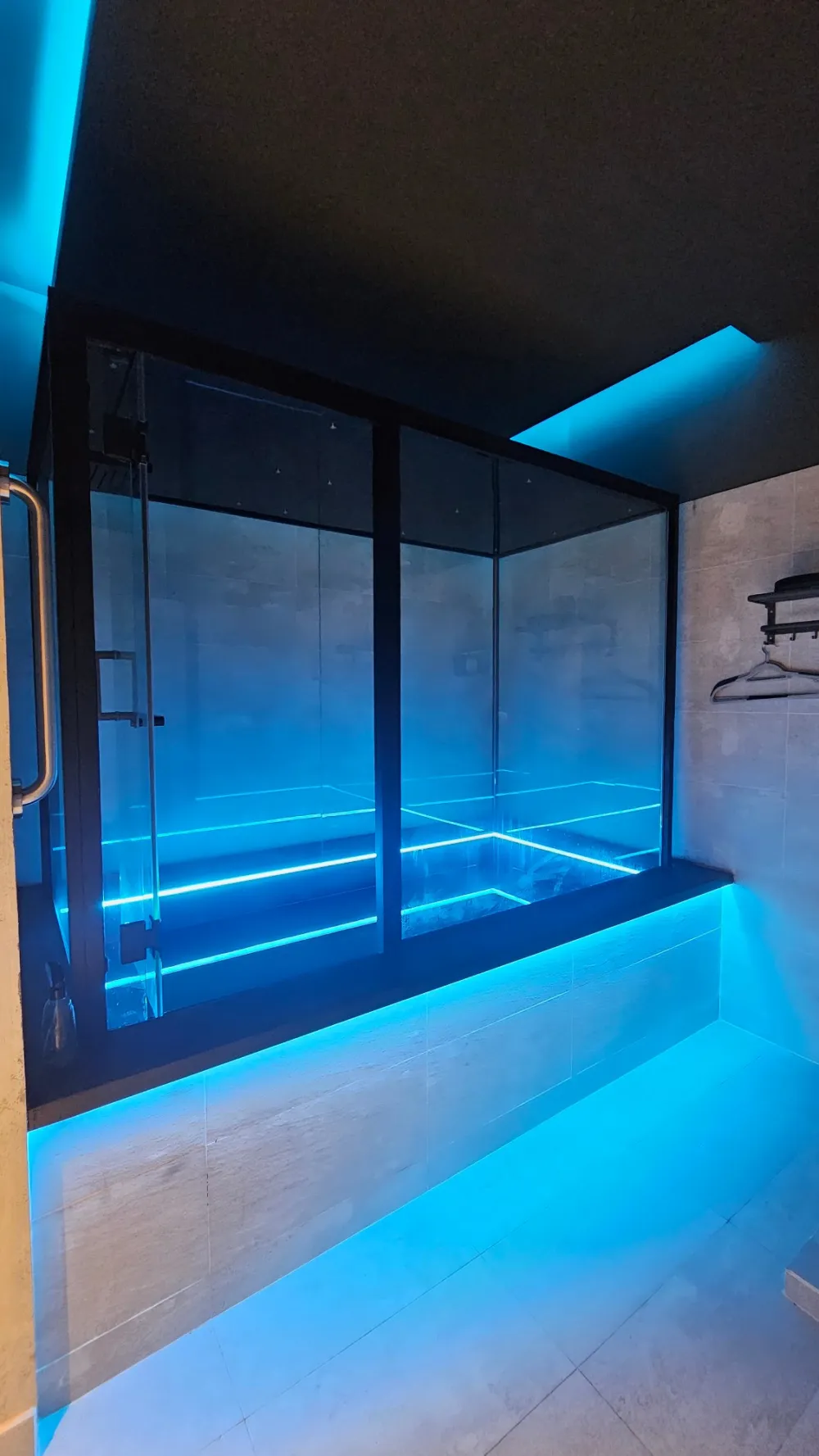
Ōmni Space opened in Thao Dien, Ho Chi Minh City, in 2025. It is the third generation of float rooms from the Float Vietnam team, which started in Hanoi in 2017 with self-built Samadhi-style tanks. At Ōmni we chose open float pools behind glass doors instead of closed pods. In the Ōmni team’s view after three generations of tanks, a well soundproofed, light-proof open room suits most people better than a pod, because it feels less stuffy and has far more air.

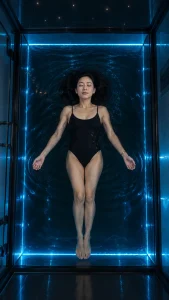
A session starts about 15 minutes before your float, with a short guide and a rinse shower. Every guest fills in a health questionnaire, and every float guest gets earplugs; a Halo neck pillow is there if you want extra support. Then you lie back in about 25 cm of water holding some 500 kg of Epsom salt, and your body simply floats.
Nothing is attached to you and no one is watching. You adjust the lights yourself: keep a soft glow, or switch everything off. The glass doors are soundproof and block all light, and the room has its own ventilation. Because the pool is open, you can sit up and step out whenever you like. Your phone can stay in the room, in a locker or at reception, and in an urgent case reception will knock on the door.
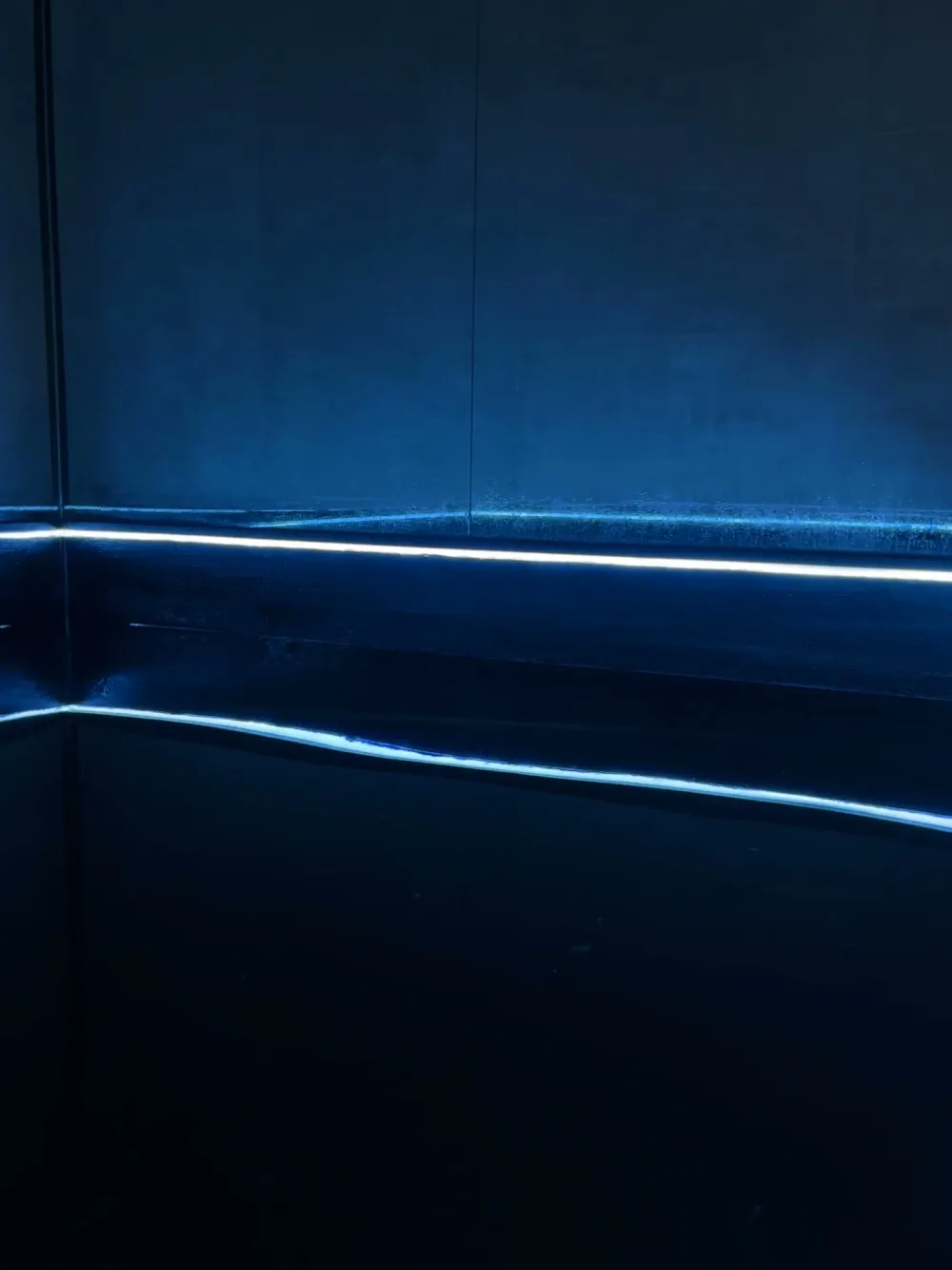
What do people actually feel? Usually not a trip to another dimension. The first minutes can feel strange, then breathing slows, the line between body and water fades, and time becomes hard to judge. Some people drift near sleep and notice faint colours or images; many notice nothing like that, and both are normal. Afterwards there is another 15 minutes or so to shower while the pump filters the water: it runs for 15 minutes after every float, and the water is disinfected with UV, hydrogen peroxide and ozone.
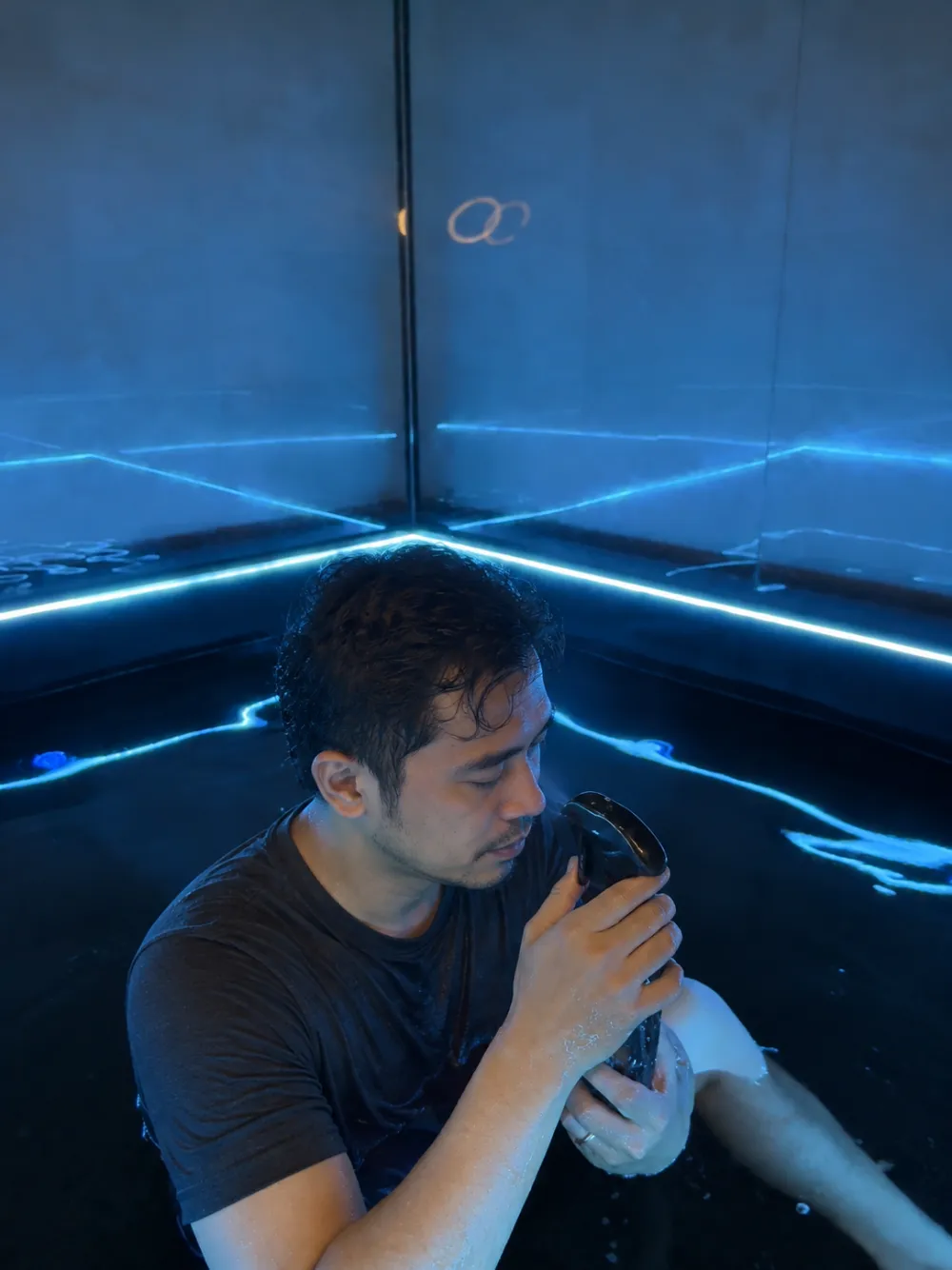
For the step-by-step version, read your first float: what to expect and, if small spaces worry you, float therapy with claustrophobia. You can see the float options on the Ōmni Space services page.
Did Stranger Things cause a float boom?
Honest answer: we don’t know, and nobody seems to. We found no Google Trends analysis, industry survey or float-centre statement crediting the show with more bookings or searches, whether in 2016, 2022 or 2025. So we won’t claim a “Stranger Things effect”.
What we can say is this. In 2016 and 2017, the press used the show as a hook for float stories: Popular Science worked out the salt, Bustle asked whether you could build a tank, and some student and city magazines sent writers to try floating because of the show. The float centre owners quoted in those pieces did not credit the show for their business.
The industry was also already growing before the first season aired. Float Tank Solutions, an industry consultancy, counted 56 US float centres in 2014, and 170 existing plus 247 planned in 2016 (vendor figures, reported by the Durango Herald). When owners explained the revival, they pointed to Joe Rogan, athletes, social media and nicer spa design.
The show clearly can move search interest: a 2022 analysis claimed searches for Dungeons & Dragons rose sharply after season 4. But that is about board games, not float tanks. The fairest summary is that Eleven’s tank became cultural shorthand. For many people who have never floated, it is the first image that comes to mind, and it is usually the first thing a real float has to gently correct. For more screen tanks, from Altered States to The Simpsons, see our companion piece on float tanks in pop culture.
Key sources
- Feinstein et al. 2018, PLOS ONE
- van Dierendonck & Te Nijenhuis 2005, Psychology & Health
- Suedfeld & Borrie 1999, Psychology & Health
- Jonsson & Kjellgren 2016, BMC Complementary and Alternative Medicine
- Kjellgren et al. 2004, Social Behavior and Personality
- Feinstein et al. 2018, Biological Psychiatry: CNNI
- Wackermann et al. 2008, Cortex
- LaBerge et al. 1981, Perceptual and Motor Skills
- Blanke et al. 2002, Nature
- Huber, Kjellgren & Passie 2025, Frontiers in Psychology
- Popular Science, 3 Aug 2016
- Rolling Stone, 8 Aug 2016
- Aeon, M. M. Owen, 2015
- Variety, 2 Apr 2015
- Peter Suedfeld, University of British Columbia: REST
- Cornell Media Studies (Jeffrey Mathias)
Note: This page is for general information. Float therapy supports wellbeing but does not replace diagnosis or treatment by a doctor. If you have a medical condition, ask your doctor before floating.
Try it at Ōmni Space. Float Vietnam’s float rooms are at 16C Quoc Huong, Thao Dien, Ho Chi Minh City (Saigon), open daily 9:00–21:00. Book a float or read the float therapy FAQ.
Frequently asked questions
Is Eleven’s sensory deprivation tank real?
The tank is real; the powers are not. Isolation tanks were first built by John C. Lilly at the US National Institute of Mental Health in 1954, and float tanks are used today for relaxation. Telepathy, entering other minds and the Upside Down are pure fiction.
Can a float tank give you hallucinations or psychic powers?
No psychic powers, ever. Some people notice mild perceptual changes, such as faint colours or dream-like images near sleep, but in studies these are rare, vague and usually pleasant. Most people simply feel deeply relaxed.
How much salt is in a real float tank, and could you build one like the kids did?
Roughly 400–800 kg of Epsom salt, depending on size; each pool at Ōmni Space holds about 500 kg. We don’t recommend a DIY tank: real tanks keep the water near skin temperature, at a precise density, and filter and disinfect it after every float.
Is floating dangerous? Can you drown?
Under normal use the risk is very low, because the water is shallow and so dense that a relaxed body floats face-up by itself. The key rule is to float sober: never under the influence of drugs or alcohol. If you have a medical condition, ask your doctor first.
Will I feel trapped in the dark like Eleven?
No. You control the light and can get out at any time. At Ōmni Space the float pools are open, behind soundproof glass doors, and you can keep a soft light on for the whole session if you prefer.