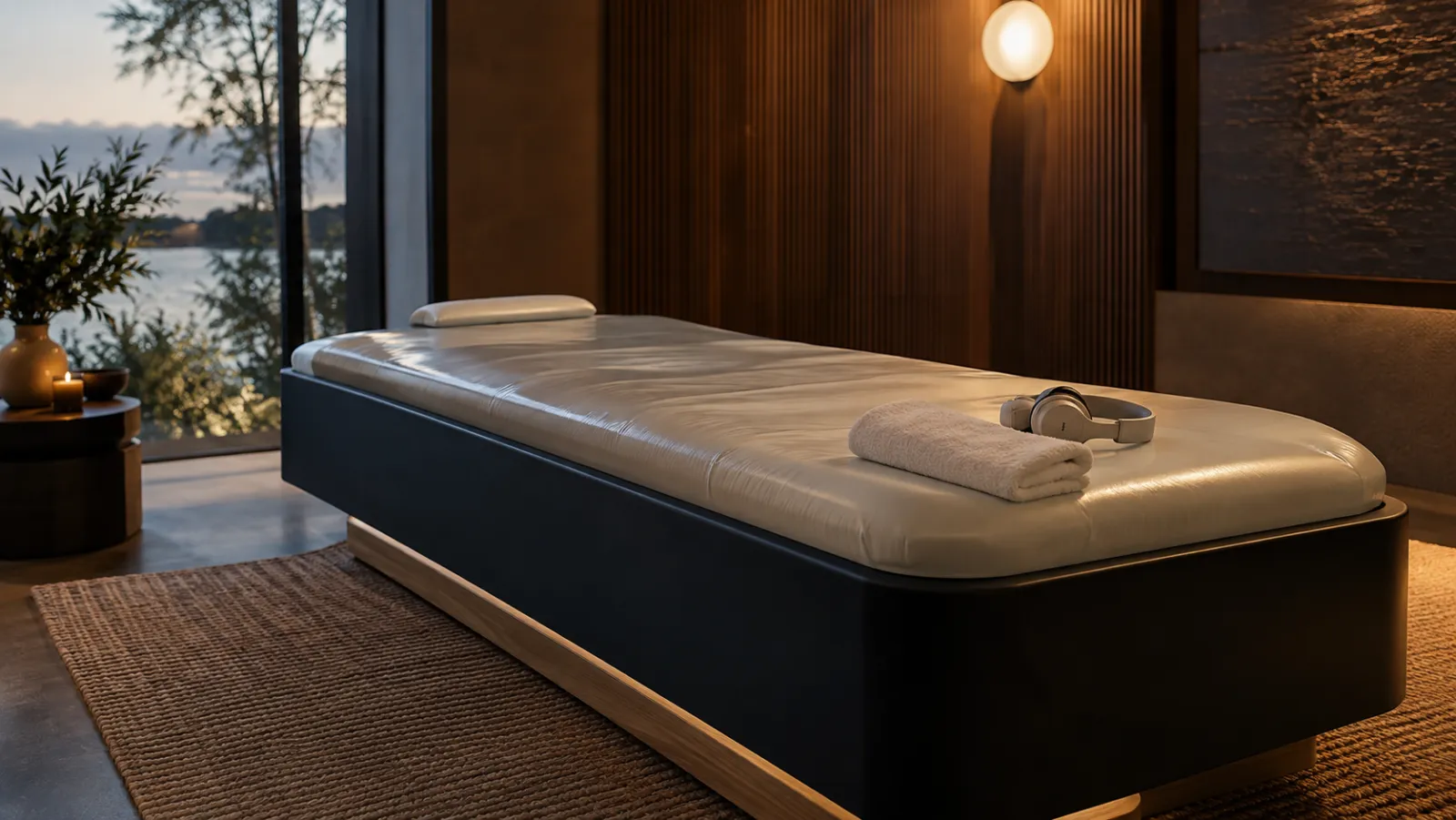
Updated: 10 Oct 2026 · By Float Vietnam
Key takeaways
- A floating sound bath is sound meditation on inflatable mats in an ordinary pool, a practice worth trying in its own right.
- A sound bath is sensory enrichment (sound is the active ingredient); float therapy is sensory reduction in skin-temperature Epsom water.
- Research on singing bowls is early and largely uncontrolled, and no study has tested sound baths on water. You can enjoy both.
Quick answer: Not quite. A floating sound bath is a sound meditation: you lie on an inflatable mat in an ordinary pool while singing bowls and gongs are played around you. It adds sensory input. Float therapy does the opposite: it reduces light and sound as far as possible while you float in dense, skin-temperature Epsom salt water.
What is a floating sound bath?
A floating sound bath is a form of sound meditation that takes place on water. Participants lie on inflatable floats or mats in an ordinary swimming pool, often wearing eye masks, while a practitioner plays singing bowls, gongs or chimes around the pool. Sessions like these run at public and private pools in the United States, Canada, the UK, Thailand and Singapore. They are usually group events, with a relaxed, social and communal feel. For many people they are an easy way into meditation: you simply lie down, relax and listen. We see this as a legitimate, enjoyable practice with real value of its own. It is just not float therapy, because the two practices aim for different things and create their effects in opposite ways, as the next sections explain.
Why are sound baths and float therapy opposites?
The core difference lies in what happens to your senses. In a sound bath, sound is the active ingredient: bowls and gongs are played on purpose to guide your attention and emotions. That is sensory enrichment. Float therapy (floatation-REST) does the reverse: sound, light, temperature cues and the pull of gravity are all reduced to a minimum. That is sensory reduction. One telling detail: in the trial by Loose and colleagues (2021), the placebo float condition added constant music and light, precisely to make the environment less like REST. In other words, for float researchers, adding sound is how you turn a float into a different experience. Neither practice is a better or worse version of the other; they simply serve different purposes and work on the mind in different ways.
What does the research say about singing bowls and sound baths?
The evidence on singing bowls is still at an early stage. The most-cited study, by Goldsby and colleagues (2017), followed 62 people through a singing bowl meditation; they reported less tension, anger, fatigue and low mood afterwards. However, it was an observational study with no control group. In 2020, Stanhope and Weinstein reviewed four studies and concluded that singing bowl therapies could not yet be recommended because there were few studies and a high risk of bias, while noting some positive signals. A 2025 systematic review found 19 clinical studies and suggested singing bowls may have potential for anxiety, mood and sleep. Notably, no study has tested sound baths done on water. Floating in salt water has a larger, though still modest, body of research; see scientific studies on floatation therapy.
How is lying on a pool float different from floating in a float tank?
Physically, the two experiences differ from the water up. Pool water has a specific gravity of about 1.00, while float water under the FTA standard is 1.23–1.30 thanks to saturated Epsom salt, so in a pool you need a mat to stay up and you have to keep your balance on it. Pool water is also not held at skin temperature (33.3–35.6 °C), so your body still notices warm and cool. An eye mask blocks light, but not sound from other participants, splashing water or the surroundings. There is also a practical point we often hear from guests: the instruments are usually some distance from many listeners, so the quality and closeness of the sound change depending on where you lie. This is a general observation, not a comment on any particular provider.
| Feature | Floating sound bath | Float therapy |
|---|---|---|
| Aim | Sensory enrichment through sound | Sensory reduction to a minimum |
| Water | Ordinary pool, specific gravity ~1.00 | Epsom salt water, specific gravity 1.23–1.30 |
| How you float | On an inflatable mat or float | Directly in the water, effortlessly |
| Water temperature | Not held at skin temperature | About 34–35 °C, close to skin temperature |
| Light | Eye mask | Dark room, or light you control |
| Sound | Instruments plus people and surroundings | Soundproofed; ears in the water |
| Format | Usually a group | Private, one or two people |
| Research | Early; none on water | Many small studies, promising results |
It is also why you cannot recreate a float at home, in a pool or in the sea; for the bigger picture, see the types of float tanks.
Who might prefer which, and can you enjoy both?
There is no single right choice for everyone. A floating sound bath may suit you if you love music, want a gentle group activity with friends, or prefer to have someone guide your attention rather than being alone with your thoughts. Float therapy may suit you better if you want real silence, want your body fully supported so your muscles can let go, or want 60 to 90 minutes of private time. If closed spaces worry you, open float rooms like those at Ōmni Space are an easier starting point than a tank with a lid; see float therapy and claustrophobia. And you can absolutely enjoy both: one session to listen, another to be still. If you are curious about what that stillness is actually like from the inside, read what sensory deprivation feels like.
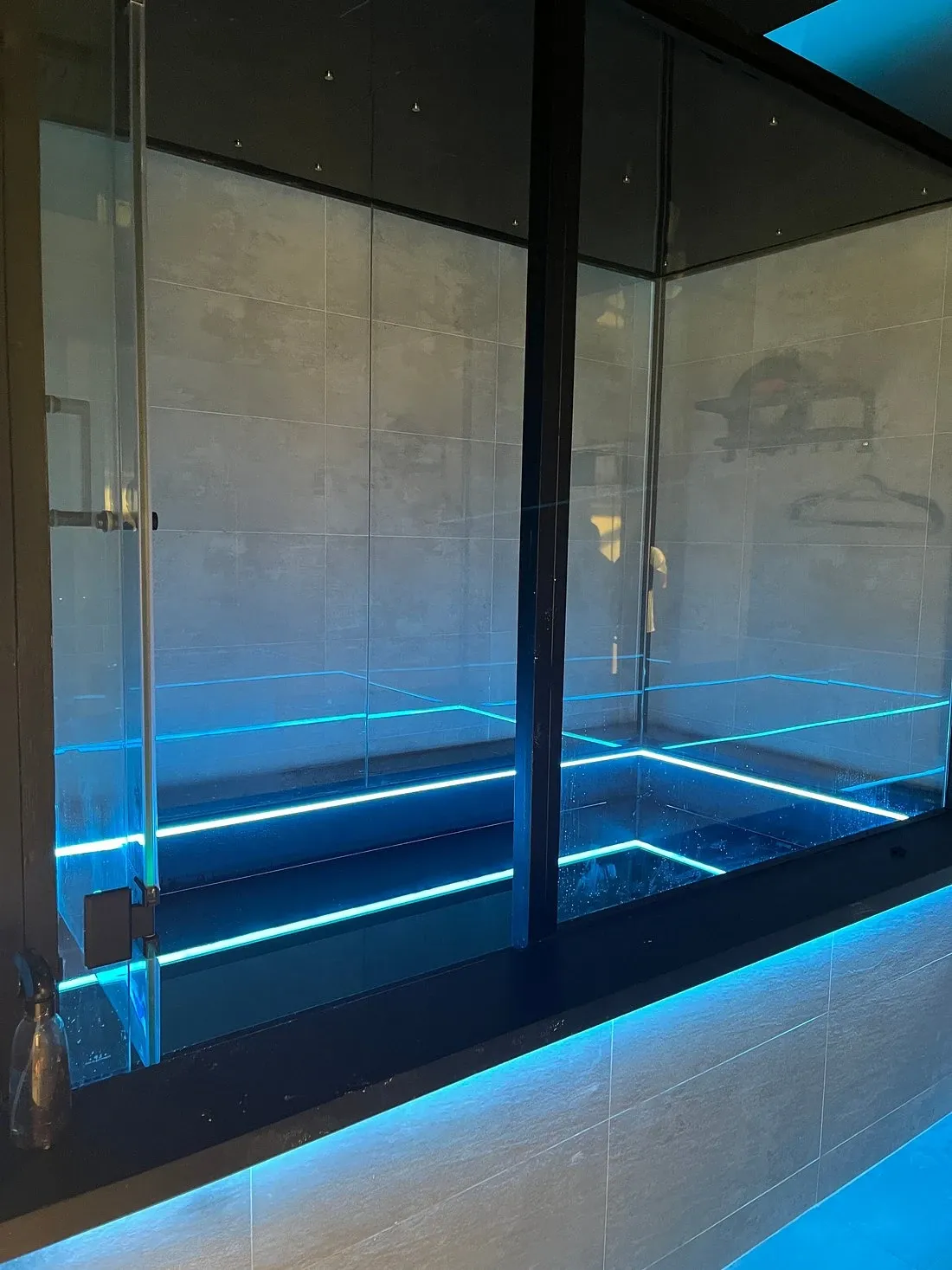
Try it at Ōmni Space. Float Vietnam’s float rooms are at 16C Quoc Huong, Thao Dien, Ho Chi Minh City (Saigon), open daily 9:00–21:00. Book a float or read the float therapy FAQ.
Frequently asked questions
Is a floating sound bath the same as float therapy?
No. A floating sound bath is sound meditation on a mat in an ordinary pool, while float therapy is floating directly in dense, skin-temperature Epsom salt water in a dark, quiet space.
Is there scientific evidence for sound baths?
It is early. Initial studies report better mood after singing bowl sessions, but most lack control groups, and no study has looked at sound baths on water.
Can you listen to music in a float tank?
Some centres play soft music at the start and end of a session, but the aim of float therapy is to reduce sound, so you spend most of the time in silence.
Can I try both?
Yes. They serve different purposes, so many people enjoy a sound bath when they want to listen and a float when they want deep quiet.