Updated: 11 Oct 2026 · By Float Vietnam
Key takeaways
- For most healthy adults, floating is a low-risk way to rest deeply. Small studies report less stress and anxiety, better mood and less post-exercise soreness.
- It is not supported as a cure for any disease, a “detox”, a magnesium supplement or a replacement for medical or psychological care.
- Effects tend to build with regular floats: try 2–3 floats a month for 2–3 months, then 1–2 a month.
Quick answer: For most healthy adults, yes: float therapy is a low-risk way to relax deeply. Small studies report less stress and anxiety, less muscle soreness after exercise and better wellbeing, and floating lowered blood pressure during sessions in one trial. Evidence is still limited, and floating complements, rather than replaces, medical care.
What does floating actually do to your body?
A float room holds about 25 cm of water with roughly 500 kg of Epsom salt dissolved in it, kept close to skin temperature at 34–35 °C. The water is so dense that you float on your back with no effort. That changes three things at once. First, gravity stops pressing on you: there are no pressure points as there are in a bed, so the muscles that hold your posture can let go. Second, the senses get a break. With the lights off, the room quiet and the water matched to your skin, the brain receives far less input than usual. Third, the body tends to shift into a resting mode. In a 2022 crossover study by Flux and colleagues, 57 adults had lower blood pressure and slower breathing during a 90-minute float than while watching a calming nature film. These are short-term changes during a session, but they explain why people describe floating as deeply restful.

What does the research support?
The strongest evidence for floating is about stress, anxiety and how people feel. In a randomised pilot trial, Kjellgren and Westman (2014) gave 37 healthy adults twelve 45-minute floats over seven weeks; compared with a waiting-list group, they reported less stress, anxiety and depression, better sleep quality and more optimism. In 2018 Feinstein and colleagues found that a single one-hour float sharply reduced state anxiety in 50 people with anxiety-related conditions, with only mild side effects such as itchy skin. Earlier, a 2005 meta-analysis by van Dierendonck and te Nijenhuis pooled 27 studies and reported positive effects on stress-related measures and wellbeing. Most recently, a 2025 systematic review by Lashgari and colleagues gathered 63 studies and found positive effects on pain, athletic performance, stress, wellbeing and clinical anxiety. The review is also honest about the weak spots: studies averaged only about 32 participants, and methods varied widely.
- Reasonably consistent: lower stress and anxiety right after floating, better mood, a strong sense of relaxation.
- Promising but small: stress-related muscle pain, recovery after exercise, regular-floater wellbeing.
- Mixed or limited: sleep disorders, long-term chronic pain, quitting smoking.
The float therapy benefits hub covers each area in depth, and the Float Vietnam whitepaper lists the studies.
Is float therapy good for recovery after exercise?
Floating is popular with athletes, and the early evidence is encouraging but small. Driller and Argus (2016) followed 60 elite athletes through a single float after training and found improvements in almost all mood measures and lower perceived muscle soreness, although there was no separate control group. In a better-controlled 2022 crossover study, Caldwell and colleagues had 11 trained men do a hard resistance workout and then either float for an hour or rest in a stimulating environment; floating reduced soreness and improved mood and fatigue scores. Not every result points the same way. Besson and colleagues (2024) compared a one-hour float with a nap in 20 active people: the nap improved heart rate variability more, while the float scored better for subjective wellbeing. And in a 2025 observational study of college athletes, Vatne and colleagues saw a lower resting heart rate the night after floating, but no change in measured sleep. Read more on floating for athletic performance.
What is NOT supported by evidence?
Being honest about the limits matters as much as listing benefits. Floating is not shown to cure, reverse or prevent any disease. Older float marketing often promised a long list of effects, from boosting the immune system and “energy” at the cell level to flushing out toxins, lactic acid or heavy metals and straightening the spine. We have not found reliable studies for these claims, so Float Vietnam does not make them. Magnesium is another common myth: a 2017 review by Gröber and colleagues in Nutrients concluded that meaningful magnesium absorption through the skin is scientifically unsupported. For chronic pain, the largest randomised trial so far, Loose and colleagues (2021), found short-term relief but no long-term benefit over a placebo condition. For sleep disorders, the 2025 review rated the evidence as limited, and a small Swedish insomnia study by Norell-Clarke and colleagues (2022) had mixed results in six people. Floating does not replace medication, therapy or a doctor’s advice.
Who is float therapy good for, and who should check first?
Floating suits most healthy adults who want a calm, screen-free way to rest. People who often enjoy it include those with stressful jobs, desk workers with tight backs and necks, runners and gym-goers, people curious about meditation who find sitting still difficult, and anyone who sleeps lightly and wants a quieter routine. Couples also float together in a shared room. Safety data are reassuring: in a 2024 randomised trial with 75 anxious or depressed adults, Garland and colleagues found six float sessions were well tolerated, with no serious adverse events. Still, a few situations call for caution. Do not float with open wounds, fresh tattoos, severe skin conditions or an infection, or after alcohol or drugs. If you have epilepsy, a heart condition, low blood pressure, kidney problems, are pregnant or have a mental health condition, ask your doctor first. If you are managing anxiety or depression, floating can sit alongside professional care, not instead of it.
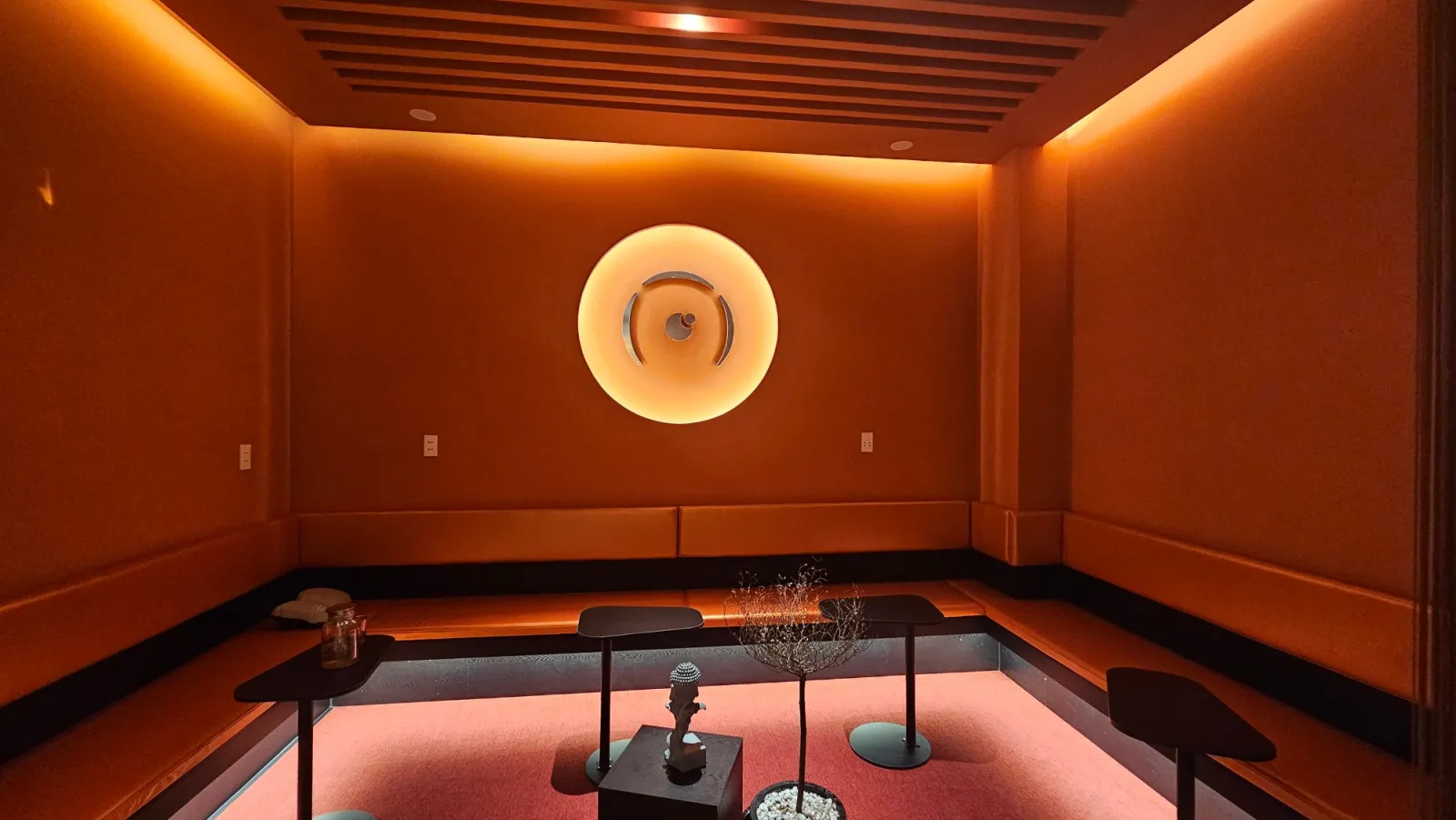
Details are in is float therapy safe?.
How often should you float to feel the benefits?
Many people feel calmer after a single float, and several studies measured effects after just one session. Deeper, longer-lasting changes in the research usually came from a series: nine floats over three weeks in Kjellgren’s 2001 muscle-pain study, and twelve floats over seven weeks in the 2014 trial with healthy adults. Your first float is also partly about getting used to the water, the dark and the quiet, so the second and third often feel more restful. Our practical guidance at Ōmni Space is to start with a 90-minute session, then float two or three times a month for the first two or three months. After about ten floats, one or two floats a month is enough for many people to maintain the effect. Listen to your own response: if you sleep better or feel less tense for days afterwards, that tells you more than any average. More in how many floats do I need?.

Note: This page is for general information. Float therapy supports wellbeing but does not replace diagnosis or treatment by a doctor. If you have a medical condition, ask your doctor before floating.
Try it at Ōmni Space. Float Vietnam’s float rooms are at 16C Quoc Huong, Thao Dien, Ho Chi Minh City (Saigon), open daily 9:00–21:00. Book a float or read the float therapy FAQ.
Frequently asked questions
Is float therapy good for you?
For most healthy adults, floating is a low-risk way to rest deeply. Small studies report lower stress and anxiety, better mood and less soreness after exercise, but evidence is limited and floating does not replace medical care.
Is it good to float every week?
Weekly floating is safe for most healthy adults. Studies have used one to three floats a week for several weeks; we suggest 2–3 floats a month at first, then 1–2 a month after about ten floats.
Does float therapy help you absorb magnesium?
This is not well supported. A 2017 review in Nutrients concluded that meaningful magnesium absorption through the skin is scientifically unsupported, so the benefits of floating come mainly from buoyancy and reduced stimulation.
Who should not try float therapy?
Avoid floating with open wounds, fresh tattoos, severe skin conditions, infections, or after alcohol or drugs. If you have epilepsy, a heart or kidney condition, low blood pressure or are pregnant, ask your doctor first.