Updated: 11 Oct 2026 · By Float Vietnam
Key takeaways
- Claude V. Swanson (1946–2022) trained as a physicist at MIT and Princeton and later wrote books arguing that a “subtle energy”, similar to qi or prana, underlies healing and paranormal events.
- These are his personal hypotheses. Mainstream physics and medicine do not accept that a subtle-energy field exists, and no instrument has measured one.
- Floating does not rely on energy theories. Its effects are explained by ordinary physiology: buoyancy, warmth, darkness, quiet and the relaxation response.
Quick answer: “Subtle energy healing” is the idea that an invisible life energy, often compared with qi or prana, flows through the body and can be used to heal. The physicist and author Claude Swanson argued for this view in his books. Mainstream science does not accept it: no reliable evidence shows that such a field exists or that manipulating it treats illness.
Who was Claude Swanson?
Claude V. Swanson was an American physicist and author. According to his memorial in the Princeton Alumni Weekly, he earned his undergraduate degree in physics at MIT and a PhD in physics at Princeton in 1976, then held a research fellowship at Cornell. He went on to work in applied physics consulting for commercial and government clients. In graduate school he was interested in unified field theory, the search for a single framework connecting the forces of nature, and he came to believe that paranormal phenomena were a missing piece of that puzzle. He set out his ideas in three books, The Synchronized Universe, Life Force and Science of the Soul. He died in Tucson, Arizona, in June 2022. We summarise his views here because readers of our Vietnamese blog have asked about them, not because Float Vietnam shares them.
What did Swanson mean by “subtle energy”?
In Swanson’s view, many cultures describe the same life force under different names, such as qi in Chinese medicine or prana in Indian traditions. He proposed that this “subtle energy” is real and physical, and that Western science simply has not yet learned to measure it. In his books he tried to connect it with several lines of argument, briefly:
- Consciousness experiments: he drew on remote-viewing research and on the Princeton Engineering Anomalies Research (PEAR) lab, which reported tiny effects of human intention on random-number machines.
- Torsion fields: he linked subtle energy to “torsion field” ideas associated with the Soviet astronomer Nikolai Kozyrev, suggesting they might explain distant healing or auras.
- A structured vacuum: he argued that empty space holds energy that the mind could imprint patterns on.
- Cosmic puzzles: he speculated that subtle energy might relate to open questions such as dark matter.
These are presented here as his ideas, in our own brief words. Readers who want the full arguments should go to his books, and should weigh them against the scientific picture below.
What does science say about subtle energy?
The scientific status is clear: there is no reliable evidence that a subtle-energy or “biofield” exists as a physical quantity, and mainstream physics and medicine do not accept it. No instrument has detected qi or a human energy field in a way that independent labs can reproduce. Torsion-field theories of the kind Swanson cited have not been confirmed by independent experiments and are widely regarded by physicists as lacking a sound basis. The PEAR lab’s results were not accepted by most of the scientific community, other groups struggled to replicate them, and the lab closed in 2007, as reported by Nature at the time.
One well-known test went straight to the core claim. In a 1998 study in JAMA, Linda Rosa, Emily Rosa and colleagues asked 21 experienced practitioners of Therapeutic Touch, a method based on sensing a “human energy field”, to say which of their hands was near the investigator’s hidden hand. They chose correctly in 123 of 280 trials, about 44%, which is no better than guessing. Some practices that use energy language, such as acupuncture, have their own clinical research, but where effects are found, researchers explain them through nerves, expectation and relaxation, not through a proven energy field.
Why do floating’s effects not need energy theories?
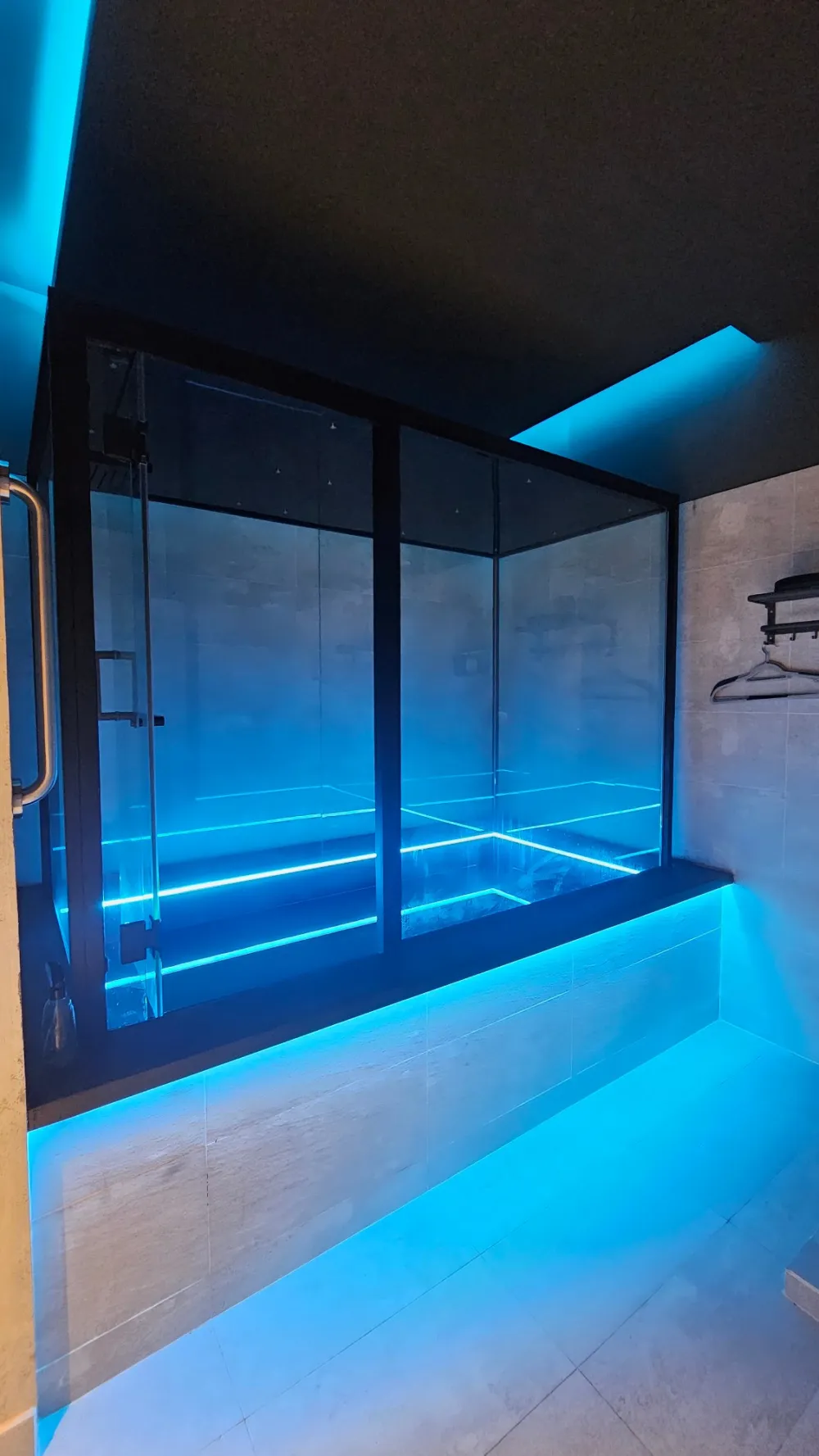
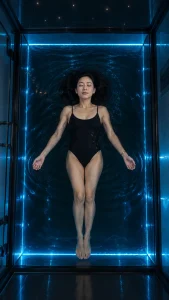
Floatation-REST (Restricted Environmental Stimulation Therapy) works through ordinary, measurable physiology. You lie in about 25 cm of water with roughly 500 kg of dissolved Epsom salt, so you float without effort. The water is close to skin temperature and the room can be completely dark and quiet. With almost no gravity, light, sound or temperature signals to process, the nervous system tends to shift towards rest: muscles release, breathing slows and many people report a calm, dreamy state. You can read more in what sensory deprivation is and how floating works.
Research supports this simple explanation. In a 2018 study in PLOS ONE, Justin Feinstein and colleagues found that a single one-hour float reduced state anxiety and improved mood in 50 people with anxiety and stress-related conditions. Studies like this measure feelings, heart rate and blood pressure; they do not need, and do not test, any subtle-energy theory. If some floaters describe sensations of energy, tingling or “flow”, those experiences are real for them and are well explained by heightened body awareness when outside input fades. See what sensory deprivation feels like.
How can you think critically about energy-healing claims?
Curiosity about consciousness is healthy, and many people come to meditation or floating with big questions. A few simple checks help separate interesting ideas from claims that could cost you money or health:
- Ask what was measured. A personal story or a theory is not the same as a controlled study with a comparison group.
- Look for independent replication. One lab’s result, especially from people promoting the idea, is weak evidence until others repeat it.
- Watch for physics words used loosely. Terms like “quantum”, “frequency” or “field” are often borrowed without the maths or experiments behind them.
- Be wary of cure claims. Any practice that promises to cure serious disease, or suggests stopping medical treatment, is a red flag.
- Keep your doctor in the loop. Complementary practices can sit alongside medical care, never replace it.
Float Vietnam’s position is simple: we offer a quiet, safe place to rest. We do not sell energy healing, and we do not claim that floating cures any condition. For a plain-language overview of the evidence, see our float therapy whitepaper.
Can a float still feel meaningful or spiritual?
Yes, and that does not depend on accepting any energy theory. Some floaters describe deep peace, vivid imagery or a sense of connection, and we have written about spiritual experiences in the float tank. Psychology and neuroscience offer grounded explanations for these states: reduced sensory input, slower brain rhythms as you drift towards sleep, and the mind’s tendency to fill silence with images and memories. You are free to find meaning in the experience. What matters is not to mistake a meaningful feeling for proof of a physical energy, or for a medical treatment.
Note: This page is for general information. Float therapy supports wellbeing but does not replace diagnosis or treatment by a doctor. If you have a medical condition, ask your doctor before floating.
Try it at Ōmni Space. Float Vietnam’s float rooms are at 16C Quoc Huong, Thao Dien, Ho Chi Minh City (Saigon), open daily 9:00–21:00. Book a float or read the float therapy FAQ.
Frequently asked questions
What is subtle energy healing?
Subtle energy healing is the belief that an invisible life energy, often compared with qi or prana, flows through the body and can be adjusted to heal. Mainstream science has found no reliable evidence that such an energy exists or treats illness.
Who was Claude Swanson?
Claude V. Swanson (1946–2022) was an American physicist with degrees from MIT and Princeton who later wrote The Synchronized Universe, Life Force and Science of the Soul. His books argue for subtle energy and paranormal phenomena, views not accepted by mainstream science.
Does float therapy work through energy fields?
No. Floating works through buoyancy, warm water, darkness and quiet, which reduce sensory input and help the body relax. Its reported effects on stress and mood are explained by ordinary physiology.
Can energy healing replace medical treatment?
No. There is no reliable evidence that energy healing treats disease, so it should never replace diagnosis or treatment by a doctor. If you use a complementary practice, tell your doctor.