Updated: 11 Oct 2026 · By Float Vietnam
Key takeaways
- Brainwaves are rhythmic electrical oscillations made by large groups of neurons firing together; an EEG records them from the scalp.
- They are grouped into five main bands: delta, theta, alpha, beta and gamma. Each band is associated with certain states rather than causing them, and band edges vary slightly between sources.
- Very few EEG studies have looked at floating. The natural ways to relax are still good sleep, meditation and giving your senses a break, for example in a float.
Quick answer: Brainwaves are the rhythmic electrical activity of the brain, measured with an EEG and sorted by speed into delta, theta, alpha, beta and gamma bands. Your brain produces all of them all the time. Sleeping, relaxing or concentrating simply changes which bands are more prominent, so no single wave is “good” or “bad”.
What are brainwaves, and what does an EEG actually measure?
Your brain has billions of nerve cells that communicate through tiny electrical signals. When large groups of them fire in step, their signals add up into rhythms strong enough to be picked up outside the skull. Those rhythms are what people call brainwaves. An EEG (electroencephalogram) uses small electrodes on the scalp to record them as wavy lines, and the key measurement is how many times per second each rhythm repeats, expressed in hertz (Hz). The German psychiatrist Hans Berger recorded the first human EEG in 1924 and described the alpha rhythm, noticing that it faded when the person opened their eyes. An EEG cannot read specific thoughts. It tells you whether brain activity is fast or slow, strong or weak, and roughly where it comes from. That makes brainwaves a fairly coarse measure of state, not a map of the mind, which is worth remembering when you see bold claims about them.
What are the five brainwave bands? Frequencies explained
Scientists name brainwave bands with Greek letters and classify them mainly by frequency. The table below uses common clinical ranges, such as those in the StatPearls review of normal EEG waveforms published on the US National Library of Medicine’s NCBI Bookshelf. Band edges differ slightly between sources: theta is listed as 4–7 Hz in some references and 4–8 Hz in others, alpha as 8–12 or 8–13 Hz, and gamma is usually counted from about 30 Hz upward, with no agreed upper limit. For everyday purposes these differences hardly matter, but they are a good reason to be sceptical of products that promise to tune your brain to an exact number. A more useful question than “what is my frequency?” is “in what situations does each band tend to show up?”, which the next section answers.
| Band | Frequency (Hz) | Typical state |
|---|---|---|
| Delta | about 0.5–4 | Deep (slow-wave) sleep |
| Theta | about 4–7 (some sources 4–8) | Drowsiness, drifting into sleep, some meditative states |
| Alpha | about 8–12 (some sources 8–13) | Awake but relaxed, especially with eyes closed |
| Beta | about 13–30 | Alert, active thinking, focused tasks |
| Gamma | above about 30 | Information processing and attention; still being researched |
What is each brainwave band associated with?
Think of brainwaves as an orchestra rather than a light switch. All five bands are present at once; as your state changes, different sections get louder. While you work, answer messages or solve a problem, beta activity tends to dominate. Close your eyes and breathe slowly, and alpha over the back of the head usually grows stronger. As you get drowsy and slip into light sleep, alpha fades and theta rises, which is also when many people notice dreamlike images. In deep sleep, large, slow delta waves take over. Gamma is the fastest band and is linked to processing and binding information, though it is hard to measure cleanly from the scalp. These are associations found in groups of people: seeing more alpha does not mean alpha is causing the relaxation. For a closer look at alpha theta brainwaves and the drowsy “twilight” state, read our guide to theta waves and float therapy.
- Alpha: common in relaxed wakefulness with eyes closed; it drops when you open your eyes or focus.
- Beta: common when alert and thinking; more beta does not automatically mean stress.
- Theta and delta: in healthy adults, mostly tied to drowsiness and sleep.
What are the most common myths about brainwaves?
Brainwaves are a popular topic, so marketing often runs ahead of the evidence. Myth one: you can switch a band on at will. In reality you can only set up conditions for relaxing or falling asleep; changes in brain rhythms follow as a result. Myth two: more alpha or theta is always better. In an awake adult, lots of theta may simply mean you are sleepy, and each band has its own job. Myth three: “brainwave entrainment” tracks, apps and gadgets are proven to put your brain into a chosen state. A 2023 systematic review in PLOS ONE by Ingendoh and colleagues looked at 14 studies of binaural beats and found inconsistent results: five supported the entrainment idea, eight contradicted it and one was mixed. The authors concluded the question cannot be settled yet. That does not mean these tools feel unpleasant, only that the claims are bigger than the data.
For combined light-and-sound stimulation (audio-visual entrainment), a 2025 review in Brain Sciences by Rahmani and colleagues described the findings as mixed, with several null or limited results, and said firm claims of efficacy are not yet warranted.
What happens to brain activity during float therapy?
The honest answer is that science knows very little so far. EEG recordings taken during floating are rare and small, so nobody can say that every float puts the brain into theta or alpha. What is well documented is how floaters describe the experience: the body lets go, time becomes hard to track, and many drift into a state between waking and sleep, sometimes with dreamlike images. That resembles the drowsy period before sleep, which is linked to theta on EEG, but it is an inference, not a measurement. The best-known brain imaging study of floating is by Al Zoubi and colleagues (2021, Human Brain Mapping) at the Laureate Institute for Brain Research in the US. It used fMRI, not EEG. After 90 minutes of floating, connectivity between the default mode network and somatomotor areas decreased; a control group resting in a zero-gravity chair showed a similar pattern.
Want to know what that drifting state feels like from the inside? Read what sensory deprivation feels like, minute by minute. For context, a classic EEG study of Zen meditators by Kasamatsu and Hirai (1966) found alpha and then theta appearing later in long sessions, mostly in experienced practitioners. A float offers similar quiet conditions; it does not replace practice. See also floatation therapy and meditation.
How can you relax naturally without forcing your brainwaves?
Rather than chasing a particular frequency, focus on habits that let your nervous system settle by itself. Regular, sufficient sleep comes first: every night your brain moves through theta and delta naturally. Meditation and slow breathing, even 10–15 minutes a day, help you get familiar with being awake but relaxed. Cutting stimulation, such as putting screens away before bed or sitting in silence for a few minutes, helps too. Floating is another option: dense salt water holds your body, the room is dark and quiet, and many people find it easier to let go than when sitting on a cushion. If sleep is your main concern, read float therapy for insomnia and sleep. No method is right for everyone, so experiment and notice how your own body responds, rather than relying on a number on a screen or an app.
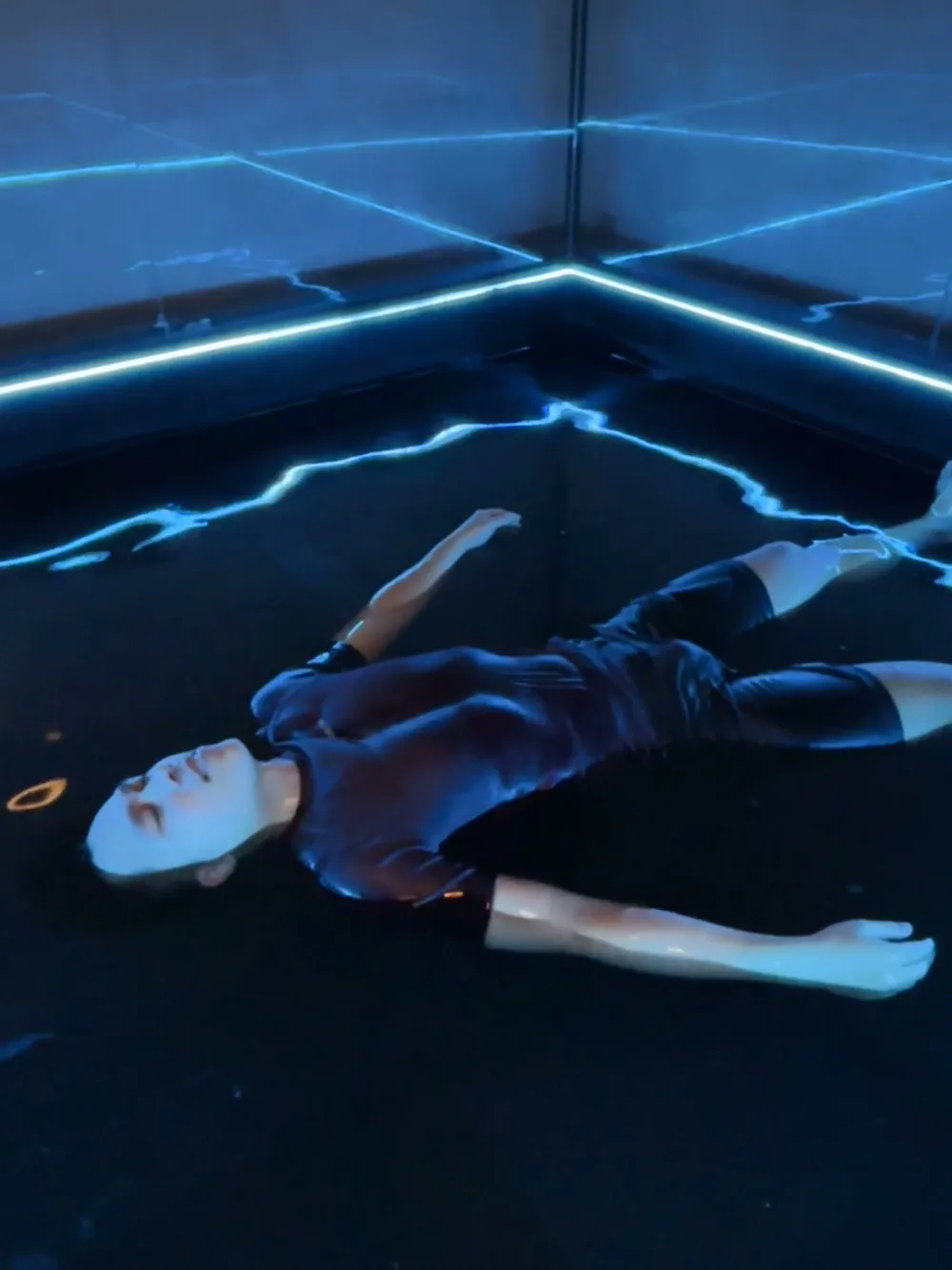
Ōmni Space also offers an add-on called “Brainwaves Neuro Align”: a 30-minute light-and-sound relaxation session you can book on its own or with a float. Think of it as something to experience, not a therapy; as noted above, research on audio-visual stimulation is limited and mixed. Details are on the Ōmni Space services page and our float pricing, or start with the overview at explore float therapy.
Note: This page is for general information. Float therapy supports wellbeing but does not replace diagnosis or treatment by a doctor. If you have a medical condition, ask your doctor before floating.
Try it at Ōmni Space. Float Vietnam’s float rooms are at 16C Quoc Huong, Thao Dien, Ho Chi Minh City (Saigon), open daily 9:00–21:00. Book a float or read the float therapy FAQ.
Frequently asked questions
What are brainwaves in simple terms?
Brainwaves are rhythmic electrical signals produced when many neurons fire together, recorded from the scalp with an EEG. They are grouped by frequency into delta, theta, alpha, beta and gamma bands.
What is the difference between alpha and theta brainwaves?
Alpha (about 8–12 Hz) is typical of being awake but relaxed, especially with eyes closed. Theta (about 4–7 or 4–8 Hz) is more typical of drowsiness and the drift into sleep, and also appears in some meditative states.
Can you increase alpha or theta brainwaves on purpose?
You cannot switch a band on at will, but you can create conditions for relaxation through meditation, slow breathing, good sleep and reduced sensory input. Evidence for brainwave entrainment products is limited and mixed.
Does float therapy put you in a theta state?
Many floaters describe a drowsy, dreamlike state similar to the edge of sleep, which is linked to theta. However, EEG studies inside float tanks are very few, so it cannot be said that this happens in every float.