Updated: 11 Oct 2026 · By Float Vietnam
Key takeaways
- In a 2014 Science study, many people found 6–15 minutes alone with their thoughts so unpleasant that some chose to give themselves a mild electric shock instead.
- Floating removes almost all outside stimulation, so it can feel unusual at first: the mind is noisy, then usually slows down as the body relaxes.
- Research on floatation-REST reports less stress and anxiety after sessions. Every float is different, and expecting nothing in particular tends to work best.
Quick answer: Being alone with your thoughts is surprisingly hard: in one well-known study, many people preferred a mild electric shock to sitting quietly for 15 minutes. Floating puts you in exactly that situation, without screens, sound or gravity. That is why it feels unusual, and why the quiet that often follows can feel so restorative.
Why is it so hard to be alone with your thoughts?
In 2014, psychologist Timothy Wilson and colleagues at the University of Virginia and Harvard published a paper in Science called “Just think: The challenges of the disengaged mind”. Across 11 studies, they asked people to sit alone in a room for 6 to 15 minutes with nothing to do but think. Most participants did not enjoy it, and they preferred simple outside activities, such as reading or using a phone, even when those were dull. In the most famous experiment, people first received a mild electric shock and many said they would pay to avoid another. Then they sat alone for 15 minutes with a button that let them shock themselves. Twelve of 18 men (67%) and six of 24 women (25%) pressed it at least once. The authors concluded that most people would rather do something, even something unpleasant, than nothing. Being alone with your own mind, it seems, is a skill few of us practise.

The 17th-century philosopher Blaise Pascal made a similar point in his Pensées, suggesting that many human troubles come from our inability to sit quietly alone in a room. For why constant input wears us down, see why the over-stimulated mind needs stillness.
Where did the idea of floating alone come from?
Floating began as a scientific question about exactly this: what does the mind do when nothing reaches it from outside? In 1954, neuroscientist John C. Lilly built the first isolation tank at the US National Institute of Mental Health. Many scientists then assumed the brain would simply go quiet, like a machine without input. Lilly found the opposite: the mind kept generating thoughts, images and states of its own. In 1972 a computer programmer named Glenn Perry attended one of Lilly’s workshops and went on to design affordable horizontal tanks filled with Epsom salt water, sold as Samadhi tanks. Commercial float centres followed in the US in the later 1970s, and the 1980 film Altered States brought floating to a wider public. Interest faded in the mid-1980s, partly through unfounded fears about shared water. In the same era, psychologists Peter Suedfeld and Roderick Borrie gave the method the research name REST. Since the 2010s, float centres have spread worldwide.
The story of the different names is told in from sensory deprivation to REST.
What happens in your mind during a float?
Most first floats follow a recognisable arc, although no two sessions are the same. At the start the mind is often loud: to-do lists, half-finished conversations, small worries and big questions all compete for attention. This is normal and is exactly what new meditators describe. Next, the body begins to let go. Many floaters only notice after 15 or 20 minutes that they have been clenching the jaw or holding the shoulders up, and that tension gradually softens. As the body relaxes, thoughts usually slow down and the gaps between them widen until there is little left but the breath. Some people then drift into a hazy state between waking and sleep, where the sense of time and of where the body ends becomes vague. Others simply rest, or fall asleep, which is safe in the buoyant water. And some sessions feel ordinary. Chasing a special state tends to push it further away.

Brain researchers link this kind of inward, wandering thought to the default mode network. For a sense-by-sense account, read what sensory deprivation feels like.
Why does floating feel so unusual, and why is that the point?
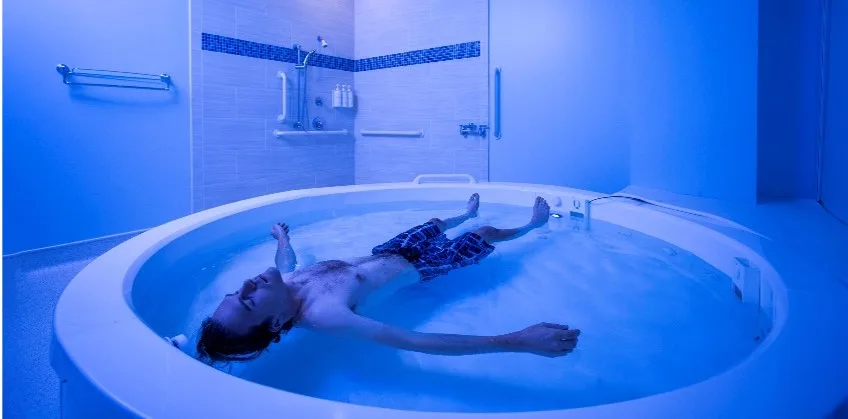
Everyday life rarely gives the brain a true break. Even when we rest, we scroll, listen or plan. A float room takes away nearly all of that at once: no light unless you want it, very little sound, water at skin temperature, and no effort needed to stay upright. For a mind used to constant input, this can feel strange, even uncomfortable, in the first minutes, much like the participants in the Wilson study. But the difference from that bare laboratory room matters. In a float, the body is warm, supported and deeply relaxed, so the shift towards rest happens in the body first, and the mind tends to follow. You are not asked to entertain yourself with your thoughts; you are given conditions in which they can settle on their own. That is the point of floating: not to escape your mind, but to spend time with it under the gentlest possible conditions, and to learn that being alone with it can be calm.
What does the research say about floating?
Researchers have studied floatation-REST for decades, mostly in small trials, and the most consistent findings concern stress and anxiety. In a 2014 randomised pilot trial, Kjellgren and Westman gave healthy adults 12 floats over seven weeks and reported lower stress, anxiety and depression scores and better sleep compared with a waiting-list group. In 2018, Justin Feinstein and colleagues at the Laureate Institute for Brain Research in Tulsa published a study in PLOS ONE in which 50 people with anxiety-related conditions floated for one hour; state anxiety dropped substantially, and mood improved. That study had no control group, and later Laureate work has used comparison conditions to test the effect more carefully. Smaller studies have explored creativity, such as Forgays and Forgays (1992). Overall, the picture is promising but early. Floating is a way to rest, not a replacement for professional care, and people with anxiety or depression should keep working with their doctor or therapist.
A wider summary is on scientific studies on floatation therapy.
What should you do after a float?
The minutes after a float are part of the experience. Lilly described coming out of the tank as if returning from another planet, and many people today say something similar: colours look brighter, small sounds stand out, and there is no hurry to do anything. Give yourself time to land. Shower slowly, then sit in a quiet space for 10 to 15 minutes with water or tea before you check your phone or step into traffic. At Ōmni Space, the lounge is there for exactly this. Some people like to jot down a few notes about what came up; others prefer to talk it over with whoever they came with, or simply sit. If your first float felt restless, that is common: the second and third sessions usually go deeper as the novelty wears off. For beginners we suggest 90 minutes, and no particular expectations about what should happen.

Try it at Ōmni Space. Float Vietnam’s float rooms are at 16C Quoc Huong, Thao Dien, Ho Chi Minh City (Saigon), open daily 9:00–21:00. Book a float or read the float therapy FAQ.
Frequently asked questions
What did the “just think” study find?
Wilson and colleagues (Science, 2014) found that most people disliked spending 6–15 minutes alone with their thoughts. In one experiment, 67% of men and 25% of women gave themselves at least one mild electric shock rather than just sit and think.
Who invented the float tank?
Neuroscientist John C. Lilly built the first isolation tank in 1954 at the US National Institute of Mental Health. The shallow, horizontal Epsom-salt tank used today developed in the 1970s, led by Glenn Perry.
Is it normal for my mind to be busy during a float?
Yes. A noisy mind is common at the start, especially in a first float. Thoughts usually slow down as the body relaxes, and many people find later sessions settle faster.
Will every float feel deep or special?
No. Some floats are profound, others are simply restful. Expecting nothing in particular and letting the session unfold tends to work better than trying to reach a certain state.