Updated: 12 October 2026 · Compiled by Float Vietnam
Key takeaways
- A darkness retreat (Tibetan mun tsam) means staying alone for days in a completely dark room. It comes from Bön and Nyingma Dzogchen in Tibet, where only experienced practitioners do it, under a teacher.
- Science has measured clear effects: the body clock “free-runs”, sleep–wake cycles stretch, people under-count the days, and most see visual hallucinations after about a day. The idea that darkness makes the pineal gland release DMT has no human evidence.
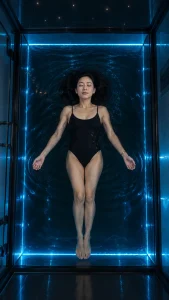
- There is no good evidence yet that darkness retreats improve health. Float therapy offers a short taste of darkness and silence in 60–90 minutes, without shifting your body clock, and you can leave anytime.
Note: This article is for information only. It is not medical advice or meditation instruction. If you live with a mental health condition, talk to your doctor or a psychologist before trying any form of sensory isolation. In Vietnam, urgent support: Ngày Mai helpline 096 306 1414, emergency 115.
Quick answer: A darkness retreat is a stay of a few hours to several weeks alone in a fully light-sealed room, with food passed in through a light-lock. In Tibetan tradition it is an advanced Dzogchen practice for recognising the mind’s own luminosity. Today commercial retreats exist in Czechia, Poland, the US and Thailand. Science shows multi-day darkness shifts the body clock and produces visual hallucinations, but no controlled study has shown health benefits. We found none operating publicly in Vietnam.
What is a darkness retreat?
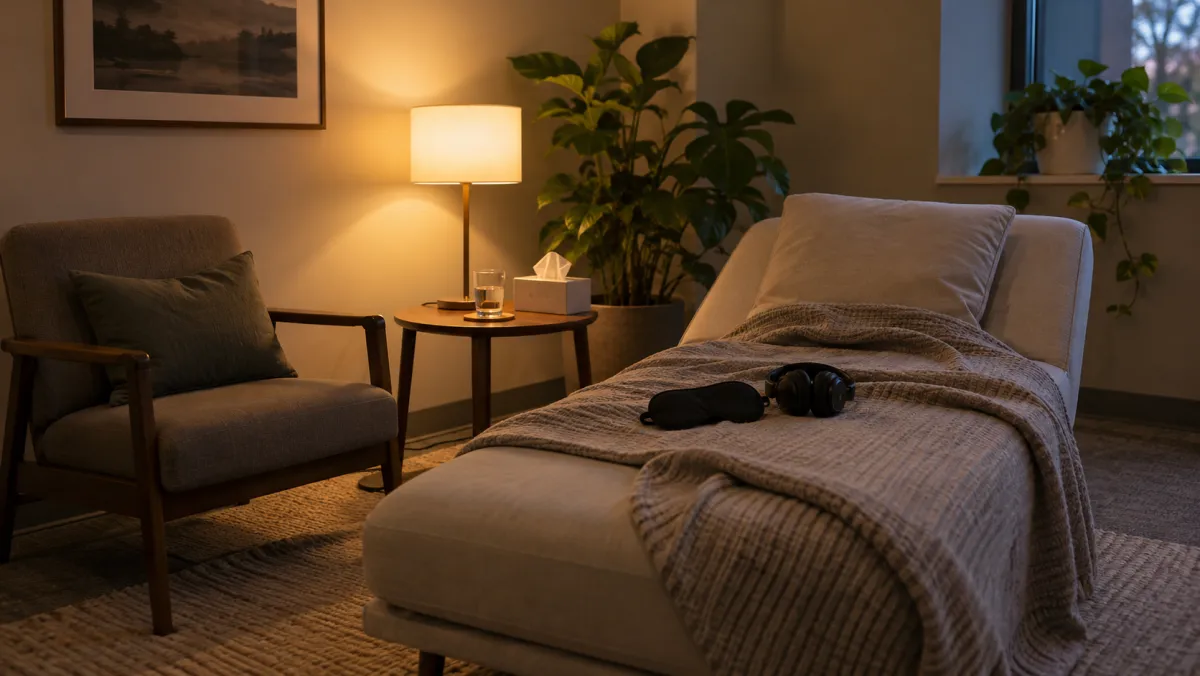
Picture it: you walk into a small room with a bed, a bathroom and water, and the door closes. Not a sliver of light gets in. You stay three, five or seven days, sometimes longer. Food arrives once a day through a light-proof hatch, and usually someone checks in through the door or an intercom. No clock, no phone, no books. Just you, your breath and total darkness.
Once a practice of Tibetan caves, the darkness retreat now appears at Western wellness centres and spreads fast on social media, especially since NFL quarterback Aaron Rodgers spent four days in the dark at Sky Cave Retreats in Oregon in February 2023. In Czechia, the Vila Mátma centre reported a waiting list of about two years (The Atlantic, 2018).
One note for Vietnamese readers: “nhập thất” in Vietnamese Buddhism means entering a small hut or room for solitary, focused practice for a set time. It is about solitude, not darkness. Dark retreat is not a Vietnamese tradition, and lineages such as Plum Village or Trúc Lâm do not teach it; Thích Nhất Hạnh’s gentle mindfulness sits almost at the opposite end from radical sensory withdrawal.
Roots: the traditions that went into the dark
Tibetan Bön and Nyingma: mun tsam, yangti and thögal
In Tibetan, mun mtshams (roughly “mün tsam”) means “darkness retreat”, and the dedicated dark building is a mun khang. The practice belongs to Dzogchen (“Great Perfection”), the highest teaching in both Bön and the Nyingma school of Tibetan Buddhism. Dzogchen has two main phases, trekchö (“cutting through”) and thögal (“direct crossing”). Dark retreat belongs to thögal, alongside sky-gazing: twin methods, one using light, one using darkness.
According to the texts, the spontaneous luminous visions of thögal unfold in four stages, from dots and threads of light to fully formed deity visions. The tradition understands them as the mind’s own display, not something from outside. Scholar Christopher Hatchell (Naked Seeing, Oxford University Press, 2014) shows that Bön, Nyingma and the Kālacakra six yogas share this “dark and light” theme. In Bön the yangti (“quintessence”) cycles are linked with dark retreat; in Nyingma there is the 15th-century Yangti Nagpo (“Black Quintessence”), though Nyingma sources stress it is a broad training, not only darkness.
The classic Bön dark retreat lasts 49 days (7 × 7), the same length as the bardo, the intermediate state between death and rebirth. The practice is often framed as “rehearsing death”, so that visions are recognised as the mind’s own. That is symbolism within the tradition, not a physiological claim.
Every source agrees it is for senior practitioners with preliminary training and a teacher. A lama who completed a 49-day retreat wrote in Tricycle (2023) that it can destabilise an unprepared mind, and suggested beginners start with a few hours. Today, Bön teacher Tenzin Wangyal Rinpoche’s Ligmincha International has cabins at Chamma Ling Colorado that can be darkened, and the Bön centre Shenten Dargye Ling in France runs 49-day thögal retreats. From the late 20th century, German ethnopsychologist Holger Kalweit helped bring “Dunkeltherapie” into German-speaking Europe.
The Kogi of Colombia: the accurate version
You may read that “the Kogi raise children in dark caves from birth for 18 years”. The record is gentler. According to anthropologist Gerardo Reichel-Dolmatoff (1976), selected boys aged about 2–3 went to live with a mama (priest) at an isolated ceremonial centre. For roughly the first nine years they lived a nocturnal life, kept from daylight and even the full moon, learning songs, dances and ritual language. At puberty they went home briefly, then returned for about nine more years. That is a night-time life, not total darkness in a cave, and it rests largely on one ethnographer’s fieldwork from the 1940s–70s. The Kogi are a living people and deserve to be described with respect.
Caves, hermits and metaphors
Christian history has the Desert Fathers and St Benedict’s roughly three years in a cave at Subiaco, but these were retreats into solitude, not systematic multi-day darkness. “Darkness” in Christian mysticism is mostly metaphor, as in St John of the Cross’s Dark Night of the Soul. Historian Yulia Ustinova (Oxford University Press, 2009) argues that Greek sages sought revelation in caves, a reading that is still debated. And in Plato’s cave, darkness is ignorance: the reverse of Tibet, where darkness is the method for seeing the mind’s light.
Mantak Chia’s “Darkness Technology”: claims to read carefully
Mantak Chia, founder of the Universal Healing Tao, runs dark-room retreats at Tao Garden in Chiang Mai, Thailand. In his “Darkness Technology” material and the book The Taoist Soul Body he claims a staged chemical sequence: days 1–3 melatonin calms body and mind, days 3–5 pinoline brings visions, and from days 6–12 the brain makes DMT and 5-MeO-DMT. He presents this as ancient Taoist practice, but no scholarly source confirms that lineage. We check these claims against the evidence below.
Your body clock in the dark: “we count days by sleeps”
Morning light resets the brain’s master clock (the suprachiasmatic nucleus) every day. Without light, the clock does not stop; it “free-runs” at its own pace. The average intrinsic human period is about 24.18 hours, in both young and older adults (Czeisler et al., 1999). Many totally blind people live with exactly this drift.
Michel Siffre, 1962. The French caver went down into Scarasson cave in the French–Italian Alps on 16 July 1962, about 130 metres underground, with no clock. He had artificial light, so this was time isolation rather than total darkness. When he was called up on 14 September, he believed it was 20 August: he had lost about 25 days. Counting to 120 at one per second took him almost five minutes. His explanation: without day–night cues, memory does not capture time, and days blur together.
Deep Time, 2021. Fifteen volunteers led by explorer Christian Clot lived 40 days in Lombrives cave, France, with no daylight, clocks or outside contact. Most thought only about 30 days had passed. The peer-reviewed results (Mauvieux et al., 2026, 13 people analysed) show 24–31 sleep–wake cycles in 40 days; average cycle length rose from 24.1 to 31.6 hours; body-temperature rhythms split from sleep early on; and group synchrony broke into loose subgroups. Normal 24-hour rhythm returned quickly in daylight. The lesson: we count days by sleeps, so longer cycles mean fewer “days”. Caveat: they had headlamps, and there was no control group.
Long nights. On a schedule with 14 hours of darkness, sleep spread out and often split into two bouts with 1–3 hours awake between, and the night-time melatonin window lengthened (Wehr 1992). That is why dark-retreat guests often report sleeping “a lot” and “in pieces”. For more on time perception, read why time speeds up as we age and float therapy and sleep.
Lights in the dark, visions and the DMT question
Long darkness almost guarantees you will “see” something. In 2004, Lotfi Merabet’s team blindfolded 13 healthy adults for 96 hours: 10 of them (77%) had visual hallucinations, from simple lights to faces, landscapes and objects. They usually began after the first day, and people knew they were not real. The mechanism resembles Charles Bonnet syndrome in people who lose their sight: a deprived visual cortex becomes over-excitable. Even 15 minutes in a dark, soundproof room produced mild perceptual disturbances and suspicious thoughts in some people, especially those prone to hallucinations (Mason & Brady, 2009). Prisoners, pilots and truck drivers informally call these coloured lights “prisoner’s cinema”.
Thögal visions (dots, threads of light, then full images) look a lot like what science records. The tradition reads them as the mind’s natural luminosity; neuroscience reads them as the visual system generating input when outside input stops, much like the predictive brain in the Ganzfeld effect. These are two languages for one experience, and we do not rank them.
Does darkness make the pineal gland release DMT?
The idea comes from psychiatrist Rick Strassman (DMT: The Spirit Molecule, 2001), who proposed that the pineal releases DMT at birth, death and in mystical states. Here is what research shows so far:
- In 2013, Barker and colleagues detected low levels of DMT in the pineal gland of rats.
- In 2019, Dean and colleagues found DMT in rat cortex at levels similar to serotonin with or without the pineal gland, and it rose in the visual cortex after cardiac arrest, also without the pineal. The authors only say this “raises the possibility” in humans. The best rat data point away from the pineal.
- Pharmacologist David Nichols (2018) notes that the adult human pineal weighs under 0.2 g, and trace brain DMT is not enough to be psychoactive.
- Melatonin does not build up day after day in darkness. It follows a daily rhythm and is suppressed by light (Lewy et al., 1980); in constant darkness that rhythm keeps cycling and drifting. Melatonin is not converted into DMT either: they are made by separate pathways.
- Pinoline as a meaningful human pineal product: no good evidence.
Bottom line: no study has measured pineal DMT rising in humans in darkness. Staged “day 3 pinoline, day 6 DMT” timelines are belief or marketing, not data. Note too that DMT is a Schedule IB substance in Vietnam under Decree 28/2026/ND-CP, and some overseas retreats combine darkness with psychedelics, which is best avoided entirely. Read more: what are psychedelics? and drug-free mind hacking.
Is a darkness retreat good for you?
Short answer: no good evidence yet. Here is what exists:
- Czechia (Malůš, Kupka & Dostál 2016): 37 Vila Mátma clients aged 25–84 spent seven days in darkness with daily therapist visits. Three weeks later, meaning in life, mindfulness and self-esteem had improved. There was no control group, and the clients were self-selected and paying.
- Slovakia (Bartolen & Soláriková 2025): a single three-hour session in a dark, quiet room (chamber REST), 120 people vs 60 matched controls: perceived stress and information overload fell modestly; sleep and rumination did not change. A second 2025 study by the same team found no significant difference from controls.
- Poland (NCT07429617): a randomised pilot at SWPS University with about 30 adults spending three days and nights in darkness, comparing one vs three check-ins per day. Estimated completion November 2026, no results yet. That researchers treat check-in frequency as a safety variable shows they take the psychological risk seriously.
“Dark therapy” in psychiatry is something else
In bipolar disorder research, “dark therapy” means supervised long nights in hospital, about 14 hours of darkness from 18:00 to 08:00, or amber blue-blocking glasses. In 2005, Barbini and colleagues found that 16 inpatients with mania given 14 hours of darkness for three nights improved faster than a comparison group, but only when started within two weeks of the episode. Darkness clearly affects mood biologically, as a supervised night-time add-on. It is not evidence that days of continuous darkness cure anything.
Risks: who should avoid it?
Multi-day darkness is not trivial. The UN Nelson Mandela Rules for the treatment of prisoners (2015) ban solitary confinement beyond 15 days and explicitly prohibit placing a prisoner “in a dark or constantly lit cell”. The psychiatric harms of forced isolation (anxiety, hallucinations, paranoia, cognitive problems) are well documented (Grassian 1983). A voluntary retreat is very different: short, chosen, meaningful, with an exit. Control and meaning change the experience. But the sensory biology is the same.
There are no systematic safety data for dark retreats. On intensive meditation retreats in general, people can experience perceptual changes, anxiety, depersonalisation and, rarely, psychosis (Lindahl et al., 2017). Avoid a darkness retreat, or consider it only after psychiatric advice, if you have:
- a personal or family history of psychosis, schizophrenia or bipolar disorder;
- PTSD or significant trauma, which can resurface with no one in the room;
- severe anxiety, panic disorder or claustrophobia;
- current suicidal thoughts, severe depression or a dissociative disorder;
- current use of recreational drugs or psychedelics;
- epilepsy (disrupted sleep can trigger seizures);
- medication that must be taken on time (insulin, anticonvulsants, lithium): without clocks, timing drifts. Talk to your doctor and never change medication yourself;
- pregnancy, unstable heart disease, frailty or a high fall risk.
If you still want to go abroad, a responsible retreat offers written screening and a conversation with a trained facilitator; a light switch or door you control, with leaving early treated as normal; at least daily check-ins and a 24/7 way to call for help; a fall-safe room; gradual re-entry to light and integration afterwards; a short start (hours, then a night, then 2–3 days); no substances; and no promises of “pineal activation” or cures. If dark, enclosed spaces worry you, see float therapy and claustrophobia.

Darkness retreat vs float therapy vs Ganzfeld
| Darkness retreat | Float therapy | Ganzfeld | |
|---|---|---|---|
| What changes | Light removed for days, usually silent and solitary | Darkness, silence and near-weightlessness in skin-temperature salt water, 60–90 min | Even light and steady noise, 20–40 min |
| Senses reduced | Vision, plus social contact and time cues | Vision, hearing, touch, gravity, temperature | Vision, hearing (made uniform) |
| Body clock | Yes: free-runs, cycles lengthen | No (back in daylight within the hour) | No |
| Typical experience | Lots of fragmented sleep, time distortion, lights then imagery after about a day, strong emotions | Deep relaxation, fading body boundaries, time distortion, mild altered state | Fade-out, coloured fog, hypnagogic imagery |
| Exit | Possible, but you have committed to days; depends on the organiser | Anytime: switch on the light or open the door | Remove the cups |
| Evidence for wellbeing | No good evidence (uncontrolled pilots) | Strong for short-term relaxation, stress and anxiety relief | No good evidence |
| Main risks | Psychological crisis, mood destabilisation, falls, circadian disruption | Low with screening | Very low |
Float therapy is an active research field with clear short-term effects: consistent trials on stress and anxiety (Kjellgren 2014, Feinstein 2018), 85–89% session adherence (Garland 2024), and a 2025 review pooling 63 studies and 1,838 participants (Lashgari et al.). A 2024 study (Hruby et al.) found that the fading of body boundaries while floating partly explained the drop in anxiety. Evidence for sleep is still early.
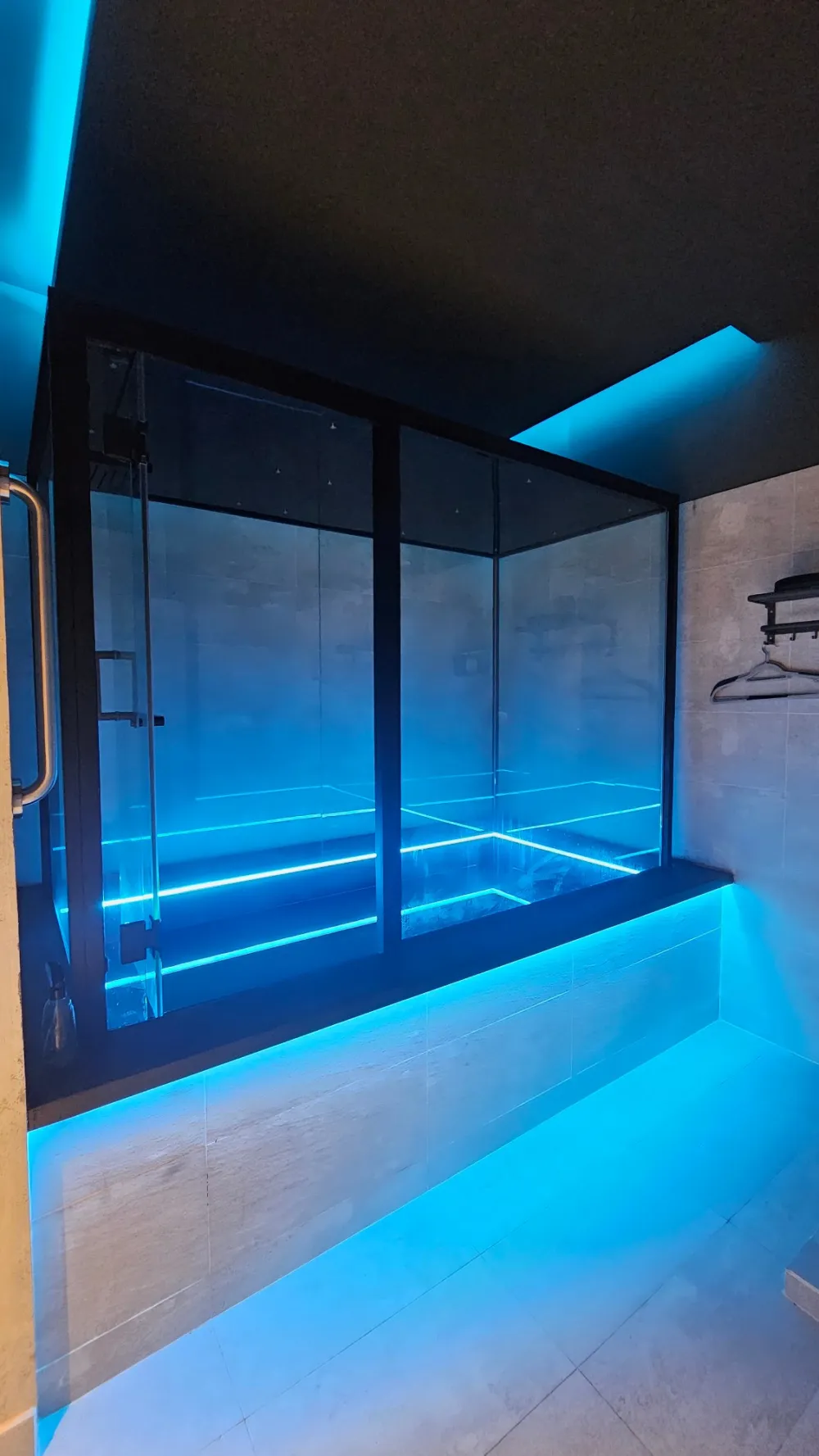
To be honest: floating is not the thögal path, it does not replace spiritual practice, and we do not promise you will see the “Clear Light” in the pool. But if darkness intrigues you, floating is a gentle first step: a short, controllable taste of darkness, silence and inner imagery, enough to learn how your mind reacts when the senses quiet down, without disrupting your body clock or committing to days alone. It is a complement, never a replacement for care. See what floating feels like, minute by minute, is float therapy safe? and the Laureate Institute float research.
Are there darkness retreats in Vietnam?
As of October 2026 we found no centre in Vietnam, Đà Lạt included, publicly offering multi-day darkness retreats. International booking sites tag about 30 Vietnamese listings as “dark retreats”, but the ones we checked (such as a four-day meditation retreat at Yên Tử) are ordinary meditation retreats with no darkness at all. Đà Lạt has monastery and yoga retreats, but none are darkness retreats. If you see a place promising “pineal activation” or “DMT awakening”, reread the sections above. For the wider science of sensory reduction, see our float therapy whitepaper.
Key sources
- Mauvieux et al. 2026, Chronobiology International (Deep Time)
- Czeisler et al. 1999, Science
- Wehr 1992, Journal of Sleep Research
- Lewy et al. 1980, Science
- Merabet et al. 2004, Journal of Neuro-Ophthalmology
- Mason & Brady 2009, Journal of Nervous and Mental Disease
- Dean et al. 2019, Scientific Reports
- Nichols 2018, Journal of Psychopharmacology
- Barbini et al. 2005, Bipolar Disorders
- Bartolen & Soláriková 2025, BMC Psychology
- Lindahl et al. 2017, PLoS One
- Grassian 1983, American Journal of Psychiatry
- Lashgari et al. 2025, BMC Complementary Medicine and Therapies
- Hruby et al. 2024, Scientific Reports
Note: This page is for general information. Float therapy supports wellbeing but does not replace diagnosis or treatment by a doctor. If you have a medical condition, ask your doctor before floating.
Try it at Ōmni Space. Float Vietnam’s float rooms are at 16C Quoc Huong, Thao Dien, Ho Chi Minh City (Saigon), open daily 9:00–21:00. Book a float or read the float therapy FAQ.
Frequently asked questions
Does darkness make the pineal gland release DMT?
There is no human evidence. The idea comes from Rick Strassman’s hypothesis and Mantak Chia’s teachings. Rat data show brain DMT does not depend on the pineal (Dean 2019), endogenous levels appear far too low to be psychoactive (Nichols 2018), and melatonin is not converted into DMT.
What happens to your body clock in multi-day darkness?
It free-runs. In the 40-day Deep Time cave study, sleep–wake cycles stretched from 24.1 to 31.6 hours on average, so people under-counted the days. Normal rhythm returned quickly in daylight.
Is a darkness retreat safe, and who should avoid it?
There are no controlled safety data. Visual hallucinations are normal after about a day, and strong emotions or trauma can surface. People with psychosis, bipolar disorder, PTSD, panic, severe depression, epilepsy or substance use should not try it without specialist advice. If you go, choose a retreat with screening, daily check-ins and a no-questions exit.
How is a darkness retreat different from floating?
A darkness retreat lasts days and shifts your body clock. Floating lasts 60–90 minutes in warm, buoyant salt water in darkness and silence, and you can leave anytime. Floating is an active research field with clear short-term effects on stress and anxiety; darkness retreats have only pilot data so far.
Are there darkness retreats in Vietnam?
As of October 2026 we found none publicly offering multi-day total darkness, Đà Lạt included. Some booking sites label ordinary meditation retreats as “dark retreats”. In Vietnamese Buddhism, “nhập thất” usually means solitary retreat, not darkness.